
Contents
- 1 What Is Salvage Farm Equipment?
- 2 The Real Value of Salvage Agricultural Equipment
- 3 Why Farmers Buy Salvage Farm Equipment
- 4 Where to Find Salvage Farm Equipment for Sale
- 5 Insurance Salvage Tractors for Sale
- 6 Understanding Agricultural Equipment Salvage Titles
- 7 Rebuilding Farm Machinery with Donor Parts
- 8 Sourcing Parts for Repairs and Restorations
- 9 Vintage Tractor Restoration Sourcing
- 10 Discontinued Tractor Components
- 11 Remanufactured vs. Salvaged Agricultural Components
- 12 Practical Tips for Evaluating Used Components
- 13 Best Practices for Buying Used Combine Attachments
- 14 Agricultural Machinery Dismantling Process
- 15 Recovering Scrap Metal Value from Obsolete Harvesters
- 16 How to Maximize Value from Salvage Farm Equipment
Farming has never been a low-cost business. Fuel, labor, repairs, parts, insurance, and machinery payments can quickly eat into already tight profit margins. For many farmers, buying brand-new equipment every time something breaks simply is not realistic.
That is why more farmers, mechanics, equipment dealers, and restoration enthusiasts are turning to salvage farm equipment as a practical and cost-saving solution.
Whether you need a replacement hydraulic pump, a donor tractor for a rebuild, a used combine header, or rare parts for an older machine, the salvage market can offer serious value. But buying from salvage yards is not the same as buying new parts from a dealership. You need to know where to look, what to inspect, and how to judge whether a part is worth the money.
If you are searching for salvage farm equipment for sale, walking through a local yard, or comparing online listings, this guide will help you make smarter decisions.
What Is Salvage Farm Equipment?
Salvage farm equipment refers to tractors, combines, implements, attachments, and machinery parts that come from damaged, retired, dismantled, or insurance-written-off agricultural machines.
A tractor may be considered salvage because of:
- Fire damage
- Flood damage
- Rollover damage
- Collision damage
- Engine failure
- Transmission failure
- Cab damage
- Electrical problems
- Age and retirement
- Insurance total loss status
But here is the important point: a damaged machine is not always worthless.
A combine with a burned cab may still have usable axles, final drives, wheels, sheet metal, hydraulic parts, or header components. A tractor with a ruined transmission may still have a strong engine. A machine that looks rough from the outside may still contain valuable parts inside.
That is the real opportunity behind salvage agricultural equipment.
The Real Value of Salvage Agricultural Equipment
The biggest reason buyers choose salvage agricultural equipment is simple: cost savings.
A used or salvaged part can often cost far less than a brand-new OEM replacement. For farmers trying to keep older equipment running, that difference can be huge.
Instead of spending thousands on a new part, you may be able to find a working salvaged component for a fraction of the price.
This is especially useful for:
- Older tractors
- Discontinued models
- Combines with expensive drivetrain parts
- Implements with hard-to-find components
- Vintage tractor restorations
- Backup machines
- Donor equipment projects
For many farms, salvage is not just about saving money. It is about keeping dependable machines working longer.
Why Farmers Buy Salvage Farm Equipment
There are several reasons farmers look for salvage farm equipment for sale instead of buying new.
1. Lower Repair Costs
New parts can be expensive, especially for engines, transmissions, hydraulic pumps, electronic monitors, axles, and final drives. Salvaged parts may offer a more affordable option.
2. Access to Discontinued Parts
Manufacturers eventually stop producing parts for older machines. When that happens, salvage yards often become the best place to locate discontinued tractor components.
3. Faster Availability
During planting or harvest season, waiting weeks for a new part can be costly. A salvage yard may already have the part on the shelf.
4. Donor Machines for Rebuilds
Some farmers buy complete salvage tractors or combines to use as donor machines. This is common when rebuilding farm machinery with donor parts.
5. Support for Vintage Restoration
For collectors, vintage tractor restoration sourcing often depends on salvage yards. Rare sheet metal, badges, wheels, engine parts, and original components may only be found through dismantled machines.
Where to Find Salvage Farm Equipment for Sale
Finding good salvage parts starts with knowing where to search. A quick search for tractor junkyard near me may bring up a few local options, but the best yards are often regional operations with large inventories and knowledgeable staff.
Local Agricultural Salvage Yards
A good local yard can be extremely valuable. Reputable agricultural salvage yards usually dismantle machines carefully, inventory usable parts, and store valuable components properly.
When choosing a yard, look for signs of professionalism:
| What to Look For | Why It Matters |
|---|---|
| Organized inventory | Saves time and reduces wrong-part risk |
| Indoor parts storage | Protects parts from weather damage |
| Knowledgeable staff | Helps with compatibility questions |
| Testing process | Reduces chance of buying bad parts |
| Clear return policy | Protects the buyer |
| Part number tracking | Helps confirm fitment |
| Shipping options | Useful if the yard is not local |
A messy yard is not always a bad yard, but if nobody knows what is available or where anything is located, buying becomes much harder.
Regional Tractor Salvage Yards
Some regions have stronger salvage markets because they have dense farming communities. The Midwest, for example, is known for large equipment yards because of the number of tractors, combines, and implements used across states like Iowa, Ohio, Nebraska, Illinois, and Indiana.
Searches such as tractor salvage yards in Ohio or tractor junkyards in Ohio are common because many buyers are looking for yards that specialize in older tractors, ag parts, and dismantled farm machinery.
Regional yards often have faster inventory turnover, which means new machines may arrive regularly. If you are hunting for a rare part, it can help to call several yards and ask to be added to a waiting list.
Online Salvage Marketplaces
Many buyers now search online for salvage farm equipment for sale before making a trip. Online listings can include:
- Salvage tractors
- Burned combines
- Damaged planters
- Wrecked balers
- Used headers
- Parts machines
- Insurance write-offs
- Dismantled equipment
- Rebuildable units
Online buying gives you more options, but it also requires caution. Ask for detailed photos, part numbers, serial numbers, condition notes, and videos when possible.
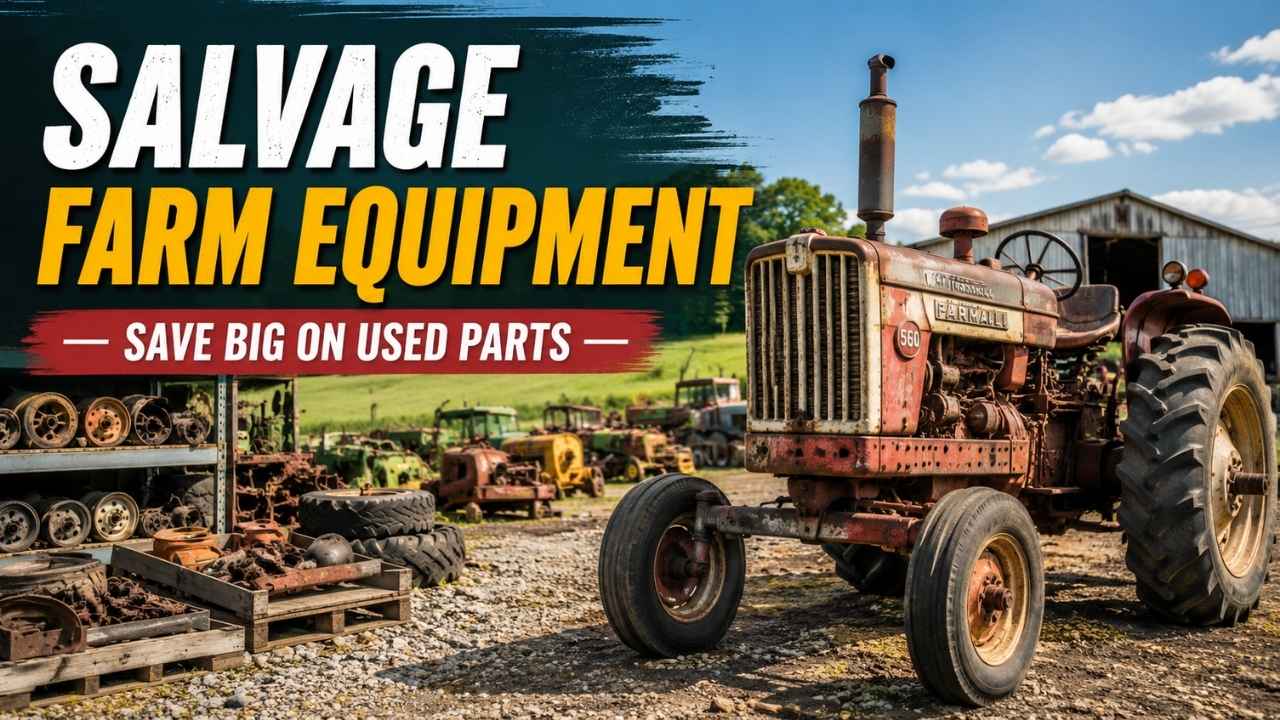
The Tractor Graveyard
A tractor graveyard is exactly what it sounds like: rows of retired, wrecked, burned, damaged, or dismantled tractors and machines waiting to be stripped for parts.
At first glance, these places can feel overwhelming. But well-run yards often organize machines by brand, model, or equipment type.
You may find rows of:
- John Deere tractors
- Case IH tractors
- New Holland machines
- Ford tractors
- Massey Ferguson tractors
- Oliver tractors
- Allis-Chalmers machines
- Combines
- Balers
- Grain heads
- Corn heads
- Planters
- Tillage tools
Before visiting, always call ahead with your machine model, serial number, and exact part number. This saves time and improves your chance of getting the correct part.
Insurance Salvage Tractors for Sale
Another major part of the salvage market is insurance salvage tractors for sale.
These are machines that an insurance company has declared a total loss. That does not always mean the machine is destroyed. Sometimes the repair cost is simply too high when calculated with dealership labor rates and new OEM parts.
For a skilled farmer or mechanic, this can create an opportunity.
A tractor with cab damage, sheet metal damage, or localized fire damage may still have a usable engine, transmission, loader, wheels, tires, axles, or hydraulic system.
Insurance Salvage Farm Equipment for Sale: What to Know
When browsing insurance salvage farm equipment for sale, documentation matters.
You need to understand:
- Why the machine was totaled
- Whether it has a salvage title
- Whether it can be insured again
- Whether it can be financed
- Whether the frame or structure is damaged
- Whether the engine and drivetrain are usable
- Whether electronics were affected
- Whether flood or fire damage is present
A cheap salvage tractor can become expensive if you overlook major hidden damage.
Understanding Agricultural Equipment Salvage Titles
Agricultural equipment salvage titles can affect the value, insurability, and resale potential of a machine.
A salvage title usually means the equipment was declared a total loss by an insurance company. Depending on the state, machine type, and lender requirements, this can affect whether the equipment can be financed or insured at full value.
Before buying a salvage-title machine, ask:
| Question | Why It Matters |
|---|---|
| Why was it totaled? | Fire, flood, rollover, collision, or mechanical failure all carry different risks |
| Can it be insured? | Some insurers may limit coverage |
| Can it be financed? | Lenders may avoid salvage-title equipment |
| Is the title clear? | Avoid ownership problems |
| Is the damage documented? | Helps estimate repair cost |
| Was the frame affected? | Structural damage can be serious |
A salvage title is not always a deal breaker, but you should know exactly what you are buying.
Rebuilding Farm Machinery with Donor Parts
One of the smartest uses of salvage equipment is rebuilding farm machinery with donor parts.
Here is a simple example:
You own a tractor with a good transmission, strong hydraulics, and solid tires, but the engine is blown. Then you find a salvage tractor with a crushed cab but a good engine. If the models are compatible, using the salvage tractor as a donor can bring your machine back to life at a much lower cost.
Donor machines are often used for:
- Engines
- Transmissions
- Axles
- Hydraulic systems
- Cabs
- Sheet metal
- Wheels and tires
- Final drives
- PTO systems
- Electrical parts
- Combine headers
- Planter row units
This approach works best when you have mechanical ability, storage space, and a clear plan before buying.
Sourcing Parts for Repairs and Restorations
Salvage yards are not just for modern farm repairs. They are also essential for restoration work.
Vintage Tractor Restoration Sourcing
For collectors, vintage tractor restoration sourcing can be challenging. Parts for older brands and discontinued models may not be available through normal dealer channels.
Salvage yards may be the only place to find original parts for brands such as:
- Oliver
- Minneapolis-Moline
- Allis-Chalmers
- Massey-Harris
- Farmall
- Ford
- Case
- John Deere
- International Harvester
Original parts can matter a lot in restoration projects. A correct grille, hood, badge, fender, seat, wheel, or engine component may affect both appearance and value.
Discontinued Tractor Components
Finding discontinued tractor components can be frustrating. A small missing part can keep an otherwise useful tractor out of service.
Salvage yards can help locate:
- Gear sets
- Hydraulic valves
- PTO shafts
- Final drives
- Carburetors
- Sheet metal
- Steering parts
- Castings
- Hitches
- Drawbars
- Front axles
- Transmission cases
When searching, always provide the model, serial number, casting number, and part number if possible.
Remanufactured vs. Salvaged Agricultural Components
When replacing expensive parts, buyers often compare remanufactured vs salvaged agricultural components.
Both options can make sense, but they are not the same.
| Option | Meaning | Pros | Cons |
|---|---|---|---|
| Salvaged component | Pulled from a donor machine | Lower cost, faster availability | Higher risk, limited testing |
| Remanufactured component | Rebuilt with new wear parts | More reliable, may include warranty | Higher price |
| New OEM component | Brand-new from manufacturer | Best fit and warranty | Most expensive |
| Aftermarket component | New part made by third party | Often cheaper than OEM | Quality varies |
A salvaged part may be fine for a low-use machine or emergency repair. A remanufactured component may be better for a high-use tractor or combine that works every season.
Compatible Drivetrain Parts Across Models
One useful trick in the salvage market is identifying compatible drivetrain parts across models.
Manufacturers often use the same or similar components across multiple machines. Engines, axles, transmissions, hydraulic pumps, final drives, and electrical parts may fit more than one model.
A knowledgeable salvage yard can cross-reference part numbers and help you find a part from a different model that still fits your machine.
This can greatly expand your options, especially when the exact model is hard to find.
Practical Tips for Evaluating Used Components
Buying used parts is not something you should do blindly. Salvage parts have already worked in the field, so inspection matters.
Inspecting Used Hydraulic Pumps for Wear
Hydraulic systems are critical on modern farm equipment. When inspecting used hydraulic pumps for wear, look carefully before buying.
Check for:
- Excessive shaft play
- Cracked housing
- Damaged fittings
- Leaking seals
- Burnt-smelling fluid
- Metal shavings in oil
- Signs of overheating
- Rust inside ports
- Rough rotation
If you see metal shavings in the hydraulic fluid, walk away. That usually points to internal failure.
Checking Engines and Transmissions
For salvaged engines and transmissions, ask whether the yard tested the part before removal.
For engines, check:
- Compression if possible
- Oil condition
- Coolant condition
- Cracks
- Blow-by
- Fire damage
- Flood exposure
- Missing sensors or accessories
For transmissions, check:
- Drain plug metal
- Case cracks
- Shift linkage
- Gear wear
- Input/output shaft play
- Fluid condition
- Signs of overheating
A cheap engine or transmission is only a good deal if it can actually be used.
Best Practices for Buying Used Combine Attachments
Combines and headers work under tough conditions. Before buying salvage attachments, follow best practices for buying used combine attachments.
Inspect:
- Auger flighting
- Sickle guards
- Knife sections
- Header floor
- Reel condition
- Gearboxes
- PTO shafts
- Belts
- Chains
- Poly skid plates
- Hydraulic cylinders
- Frame cracks
- Sensor wiring
A used header may look affordable, but repair costs can rise quickly if all the wear parts need replacement.
Evaluating Market Value of Salvaged Grain Headers
When evaluating market value of salvaged grain headers, do not focus only on the asking price.
Calculate the total cost:
| Cost Factor | Why It Matters |
|---|---|
| Purchase price | Starting cost |
| Replacement guards and sections | Common wear items |
| Auger repair | Can be expensive |
| Header floor repair | Labor-intensive |
| Transport cost | Headers are large and costly to move |
| Adapter compatibility | Must fit your combine |
| Electronics/sensors | Modern headers may require working wiring |
| Time to refurbish | Delays can matter during harvest |
A cheap header may not be cheap if it needs thousands in parts before it can go to the field.
Agricultural Machinery Dismantling Process
The agricultural machinery dismantling process is more organized than many people think.
A professional yard usually follows several steps:
- Identify the machine and record the serial number.
- Drain engine oil, hydraulic fluid, coolant, fuel, and other fluids.
- Remove high-value electronics such as GPS units, displays, and monitors.
- Remove usable body panels, wheels, tires, and attachments.
- Pull the engine, transmission, axles, and hydraulic components.
- Clean, tag, test, and store parts.
- Scrap the remaining frame or unusable material.
This process allows salvage yards to recover value while reducing waste.
Common Types of Tractor Wrecking Services
Tractor wrecking services help farmers dispose of dead, burned, wrecked, or obsolete equipment.
Common services include:
- Tractor dismantling
- Combine dismantling
- Part removal
- Scrap hauling
- Equipment pickup
- Salvage appraisal
- Insurance salvage handling
- Used parts resale
- Metal recycling
If you have an old machine sitting in a fence row, a wrecking service may be able to remove it and pay based on usable parts or scrap weight.
Recovering Scrap Metal Value from Obsolete Harvesters
Large machines like combines can contain a significant amount of scrap metal. Recovering scrap metal value from obsolete harvesters can help farmers turn dead equipment into cash.
The final value depends on:
- Machine weight
- Current scrap prices
- Usable parts remaining
- Tire and wheel condition
- Engine and drivetrain value
- Transport distance
- Local recycling rates
A machine that no longer runs may still have value in steel, cast iron, copper wiring, aluminum, and usable parts.
Eco-Friendly Disposal of Non-Functional Farm Assets
Old equipment left outside for years can leak oil, fuel, coolant, hydraulic fluid, and battery acid into the soil. Professional salvage and recycling supports the eco-friendly disposal of non-functional farm assets.
This helps:
- Reduce waste
- Recycle steel and metals
- Prevent soil contamination
- Reduce demand for newly mined materials
- Remove unsafe equipment from the farm
- Keep usable parts in circulation
Salvage is not only about saving money. It can also be a more responsible way to handle retired machinery.
How to Maximize Value from Salvage Farm Equipment
To get the most from salvage farm equipment, treat the process like a strategy, not a gamble.
Build Relationships with Salvage Yards
Good relationships matter. If a yard knows what equipment you run, they may call you when a matching machine arrives.
Keep a list of:
- Tractor models you own
- Combine models
- Part numbers
- Serial numbers
- Common wear items
- Backup parts you may need
- Hard-to-find components
Keep Critical Spare Parts on Hand
If you operate older equipment, consider keeping common failure parts in stock, such as:
- Hydraulic hoses
- Belts
- Bearings
- PTO parts
- Sensors
- Filters
- Electrical connectors
- Used hydraulic pumps
- Starter motors
- Alternators
This can reduce downtime during busy seasons.
Compare Salvage, Remanufactured, and New
Do not always choose the cheapest option. For a low-use tractor, salvage may be fine. For a main harvest machine, remanufactured or new may be safer.
Factor in Labor
A $500 salvaged part is not always cheaper than a $1,200 rebuilt part if the salvage part fails and you have to do the job twice.
Salvage farm equipment can be one of the smartest ways to lower machinery costs, especially when new parts are expensive or no longer available. From insurance salvage tractors for sale to tractor graveyard finds, used combine attachments, donor machines, and rare vintage parts, the salvage market offers real opportunities for farmers who know how to inspect and buy carefully.
The key is to stay practical. Check part numbers, inspect condition, understand salvage titles, compare repair costs, and build relationships with reputable agricultural salvage yards.
Whether you are repairing a daily-use tractor, restoring a vintage machine, or rebuilding farm machinery with donor parts, the right salvage part can keep your equipment working and your repair budget under control.
The next time a machine breaks down, do not assume the dealership is your only option. The part you need may already be waiting in a salvage yard, ready to return to the field.