
Contents
- 1 What Are Compact Tractor Salvage Yards?
- 2 Why Buy Used OEM Tractor Parts?
- 3 Common Parts Found at Compact Tractor Salvage Yards
- 4 How to Find Compact Tractor Salvage Yards Near You
- 5 Use Dismantled Equipment Listings
- 6 Call Before You Drive
- 7 Know Your Tractor Model and Serial Number
- 8 What to Inspect Before Buying Used Tractor Parts
- 9 Parts That Are Usually Good to Buy Used
- 10 Parts That Require Extra Caution
- 11 Compare Salvage Yard Prices With Dealer Prices
- 12 Ask About Warranty and Returns
- 13 Should You Buy From Local Yards or Online Salvage Networks?
Finding affordable replacement parts for a compact tractor can feel frustrating, especially when a dealer quote costs more than expected. Whether you own a John Deere, Kubota, New Holland, Ford, Massey Ferguson, Kioti, Mahindra, or Case IH compact tractor, one thing is clear: new OEM parts are not always cheap.
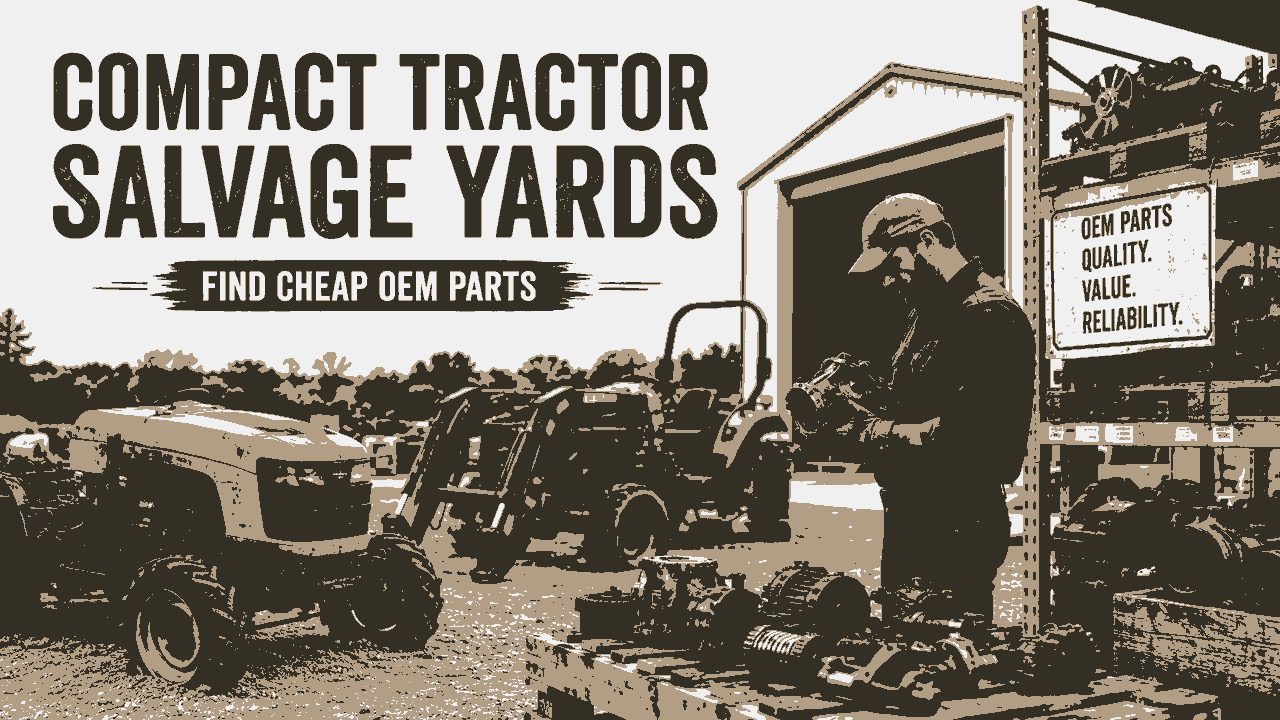
That is why more tractor owners are turning to compact tractor salvage yards to find used OEM parts at a much lower cost.
A good salvage yard can be a goldmine for anyone trying to repair an older compact tractor, restore a machine, replace damaged components, or keep a working tractor running without spending dealership-level money. From hydraulic pumps and transmissions to hoods, fenders, rims, engines, seats, loaders, and three-point hitch parts, salvage yards often carry parts that are hard to find anywhere else.
But here is the important part: not every used tractor part is a good deal.
To save money and avoid buying junk, you need to know where to look, what to ask, and how to inspect used compact tractor parts before paying. This guide explains how compact tractor salvage yards work, how to find cheap OEM parts, and how to make smarter buying decisions.
What Are Compact Tractor Salvage Yards?
Compact tractor salvage yards are businesses that buy damaged, worn-out, wrecked, burned, non-running, or retired tractors and dismantle them for usable parts. Instead of sending the entire machine to scrap, these yards remove valuable components and resell them to tractor owners, mechanics, repair shops, farmers, landscapers, and property owners.
Some salvage yards focus only on agricultural tractors. Others handle compact tractors, utility tractors, skid steers, mowers, backhoes, loaders, and other equipment.
A compact tractor salvage yard may sell parts from machines that were:
- involved in accidents
- damaged by fire
- traded in as non-running units
- retired from farms or landscaping businesses
- stripped for parts after engine or transmission failure
- purchased from auctions
- taken in from dealers or insurance claims
The tractor may no longer be useful as a complete machine, but many of its parts may still be in excellent working condition.
For example, a compact tractor with a blown engine may still have a good transmission, front axle, loader frame, hydraulic cylinders, rims, seat, lights, steering components, PTO parts, and sheet metal. Salvage yards make money by separating these usable components and selling them individually.
Why Buy Used OEM Tractor Parts?
The biggest reason people search for used compact tractor parts is price. A used OEM part from a salvage yard can often cost significantly less than a brand-new dealer part.
But price is not the only advantage.
OEM stands for Original Equipment Manufacturer. That means the part was made for that tractor model or supplied to the original manufacturer. In many cases, a used OEM part will fit better than a cheap aftermarket replacement.
Used OEM parts can be especially helpful when:
- the original part is discontinued
- the dealer has a long backorder delay
- aftermarket parts do not fit correctly
- the tractor is older and not worth expensive new parts
- you need a temporary repair to keep working
- you are restoring a vintage or older compact tractor
- you want factory-quality components at a lower price
For many tractor owners, the best repair is not always the newest part. Sometimes the best repair is a clean, original OEM part pulled from a donor machine.
Common Parts Found at Compact Tractor Salvage Yards
A well-stocked compact tractor salvage yard may carry thousands of parts across many tractor brands and models. Inventory changes constantly, but common salvage parts include:
- engines
- engine blocks
- cylinder heads
- starters
- alternators
- fuel tanks
- injection pumps
- radiators
- cooling fans
- hydraulic pumps
- hydraulic cylinders
- hydraulic valves
- transmissions
- clutches
- front axles
- rear axles
- PTO shafts
- three-point hitch arms
- drawbars
- steering boxes
- power steering parts
- rims and tires
- loader arms
- loader brackets
- backhoe attachments
- seats
- dashboards
- gauges
- hoods
- fenders
- grills
- lights
- wiring harnesses
- roll bars and ROPS parts
Some parts are easier to buy used than others. Sheet metal, rims, tires, seats, brackets, drawbars, and hitch parts are usually safer purchases because you can visually inspect their condition. Internal parts like transmissions, hydraulic pumps, and engines require more caution because problems may not be obvious from the outside.
How to Find Compact Tractor Salvage Yards Near You
The easiest place to start is online search, but you need to use the right keywords. Many small salvage yards do not rank well for simple searches like “tractor parts near me.” Some use different terms such as dismantled tractors, ag equipment salvage, tractor wrecking yard, or used equipment parts.
Try searching:
- compact tractor salvage yards near me
- used compact tractor parts
- tractor salvage yards
- dismantled compact tractors
- used OEM tractor parts
- Kubota salvage parts
- John Deere compact tractor parts used
- New Holland tractor salvage parts
- tractor junkyard near me
- farm equipment salvage yard
- tractor dismantlers
- used tractor parts online
You should also search by brand and model. For example:
- John Deere 1025R used parts
- Kubota BX parts salvage
- New Holland Boomer used parts
- Ford compact tractor salvage
- Kioti tractor used parts
- Mahindra tractor salvage parts
Brand-specific searches often produce better results because salvage yards may list individual machines by model number.
Use Dismantled Equipment Listings
Many salvage yards now list their inventory online as dismantled machines. This is extremely useful because you can see which tractors are being parted out before calling.
A dismantled listing may show:
- tractor brand
- model number
- condition
- photos
- serial number
- available components
- location
- dealer or yard contact information
If you find your exact model listed as dismantled, call immediately. Popular parts can sell quickly, especially for common compact tractor models like John Deere 1023E, John Deere 1025R, Kubota BX series, Kubota B series, New Holland Boomer, Ford compact tractors, and older utility models.
When calling, do not just ask, “Do you have parts for this tractor?” Be specific.
Say something like:
“I’m looking for a used hydraulic pump for a Kubota B-series tractor. The model is B2601, and I can provide the part number and photos. Do you have a donor machine or matching pump available?”
That kind of request saves time and makes it easier for the parts person to help you.
Call Before You Drive
Never drive two or three hours to a salvage yard without calling first. Inventory changes fast, and some yards store parts in different areas.
Before visiting, ask:
- Do you have my tractor make and model?
- Is the part still on the tractor or already removed?
- Has the part been tested?
- What is the condition?
- Are there photos available?
- Is there a warranty or return policy?
- Do you ship parts?
- Can you hold the part?
- Do I need to bring tools and remove it myself?
- What payment methods do you accept?
This simple phone call can save you a wasted trip.
Know Your Tractor Model and Serial Number
One of the biggest mistakes buyers make is shopping by appearance instead of exact fit. Compact tractors can look very similar across model years, but small differences can affect compatibility.
Before buying any used part, write down:
- tractor make
- tractor model
- serial number
- engine model
- transmission type
- part number if available
- loader model if relevant
- attachment model if relevant
A John Deere compact tractor, for example, may have different hydraulic, electrical, or frame components depending on production year and configuration. Kubota BX and B-series tractors may also have model-specific differences that matter when buying used parts.
If possible, remove the old part and compare casting numbers, bolt patterns, spline count, connector types, hose fittings, and mounting points.
What to Inspect Before Buying Used Tractor Parts
Used parts can save money, but inspection is everything. A cheap part is not a bargain if it fails two weeks later.
For metal parts, check:
- cracks
- deep rust
- bent mounting points
- broken welds
- worn holes
- damaged threads
- missing brackets
- signs of impact
For hydraulic parts, check:
- leaks
- shaft wear
- damaged seals
- contaminated oil
- scoring
- cracked housings
- loose fittings
For electrical parts, check:
- broken connectors
- brittle wiring
- corrosion
- burn marks
- cut harnesses
- water damage
For engines and transmissions, ask:
- Was it tested?
- Did it run before removal?
- How many hours were on the donor tractor?
- Was there any smoke, noise, slipping, or overheating?
- Is there a startup warranty?
- Can you provide compression or pressure test results?
You do not need to be a professional mechanic, but you do need to slow down and inspect carefully.
Parts That Are Usually Good to Buy Used
Some compact tractor parts are better salvage-yard purchases than others.
Good used parts often include:
- sheet metal
- hoods
- fenders
- grills
- seats
- rims
- wheel weights
- drawbars
- three-point hitch arms
- loader brackets
- lights
- dashboards
- fuel tanks
- ROPS components
- PTO shields
- hydraulic cylinders if clean and dry
These parts are usually easier to inspect visually. If they are straight, clean, and not cracked, they may be worth buying used.
Parts That Require Extra Caution
Some parts can still be good purchases, but they require more careful inspection.
Be cautious with:
- engines
- transmissions
- hydraulic pumps
- injection pumps
- electronic control modules
- wiring harnesses
- hydrostatic drive components
- clutches
- differentials
- final drives
These parts can be expensive to install. If they fail after installation, you may lose both the part cost and labor cost. For these components, always ask about testing, warranty, and return policy.
Compare Salvage Yard Prices With Dealer Prices
Before buying, compare the used part price with the new OEM price and aftermarket options. Sometimes a salvage yard part is a great deal. Other times, the price difference may not be large enough to justify the risk.
A simple rule:
If the used part costs 30% to 50% of the new OEM price and has a warranty, it may be worth considering.
If the used part costs 80% of new and has no warranty, buying new may be smarter.
Also remember shipping costs. Heavy compact tractor parts can be expensive to ship, especially engines, transmissions, axles, rims, and loader components. A cheap part can become expensive after freight charges.
Ask About Warranty and Returns
Every salvage yard has different policies. Some offer 30-day warranties. Others sell everything as-is.
Before paying, ask clearly:
- Is this part guaranteed?
- Can I return it if it does not fit?
- What happens if it fails during installation?
- Is there a restocking fee?
- Do you offer exchange only or refund?
- Is shipping refundable?
Get the answer in writing if possible, especially for expensive parts.
Should You Buy From Local Yards or Online Salvage Networks?
Both options can work.
Local salvage yards are useful because you can inspect parts in person, avoid freight costs, and build relationships with parts sellers. They are especially good for large or fragile parts.
Online salvage networks are useful when you need a rare part and local yards do not have it. They may also have better search tools and larger inventories.
The best strategy is to use both.
Start local, then expand your search regionally or nationally if needed.
Compact tractor salvage yards are one of the best places to find cheap OEM parts, especially if you own an older or discontinued model. They can help you save money, avoid long dealer delays, and keep your tractor working without overspending.
The key is to shop carefully.
Know your tractor model, confirm part numbers, inspect condition, ask about warranties, and compare prices before buying. A used OEM part can be a smart repair solution, but only if it fits correctly and has enough life left to justify the cost.
For farmers, landscapers, property owners, and compact tractor enthusiasts, salvage yards are more than junkyards. They are practical parts sources filled with hidden value.
The next time your compact tractor breaks down, do not assume the dealership is your only option. A dismantled tractor sitting in a salvage yard may have the exact OEM part you need — at a price that keeps more money in your pocket.