Contents
- 1 John Deere 5075E Overview
- 2 John Deere 5075E Specs
- 3 John Deere 5075E HP and PTO Power
- 4 John Deere 5075E Weight and Stability
- 5 John Deere 5075E Price: New and Used Market
- 6 John Deere 5075E for Sale: What to Check Before Buying
- 7 John Deere 5075E Problems and Owner Complaints
- 8 John Deere 5075E Warning Lights and Dash Lights
- 9 John Deere 5075E Maintenance: Filters, Oil, Battery, and Fluids
- 10 John Deere 5075E Loader Use
- 11 John Deere 5075E Cab vs Open Station
- 12 John Deere 5075E vs 5075M
- 13 John Deere 5075E vs Kubota M7060 or M4-071
- 14 Is the John Deere 5075E a Good Tractor?
- 15 Buying Advice
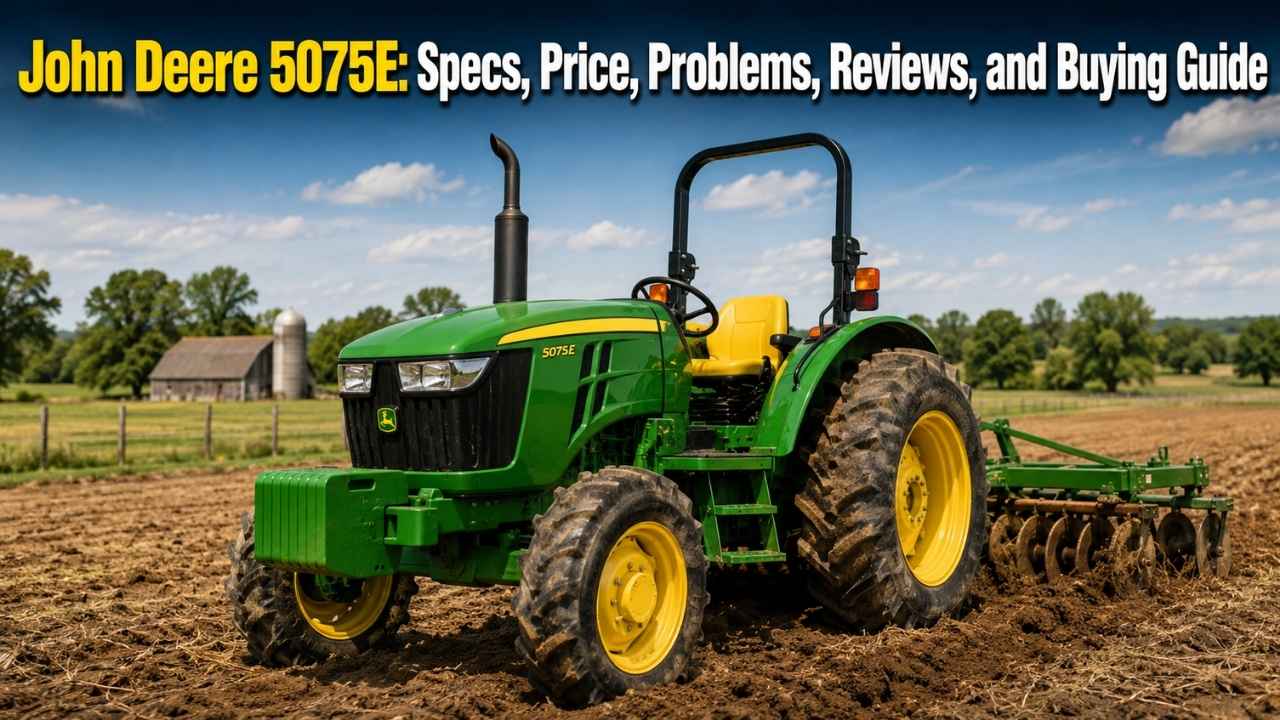
The John Deere 5075E is one of those utility tractors that sits in a very useful middle ground. It is not too small for real farm work, but it is also not so large that it becomes expensive, heavy, or difficult to manage around small fields, livestock areas, hay operations, and general property maintenance.
For many buyers, the big attraction is simple: the John Deere 5075E tractor offers around 75 engine horsepower, useful PTO power, loader compatibility, available cab or open station configurations, and a reputation as a practical workhorse in the utility tractor class. According to John Deere’s current 5E Series information, the 5075E is listed at 75 engine horsepower and 57.6 PTO horsepower in the lineup. (John Deere)
This guide covers the most searched topics around the model, including John Deere 5075E specs, horsepower, PTO power, weight considerations, price, used buying advice, common problems, maintenance points, and whether it is the right tractor for your farm.
John Deere 5075E Overview
The 5075E John Deere is part of the 5E utility tractor family. It is commonly used for loader work, mowing, hay handling, light tillage, material moving, feeding livestock, property cleanup, and general farm chores.
John Deere lists the 5075E with a 3-cylinder 2.9L PowerTech engine, 75 rated horsepower, and transmission options that include a standard SyncShuttle 9F/3R and optional PowrReverser 12F/12R depending on configuration and market.
That makes the tractor especially appealing to buyers who want more capability than a compact tractor but do not necessarily need a high-horsepower row-crop machine. It is the kind of tractor many owners consider for mixed-use work: pulling a rotary cutter, running a small square baler, moving round bales with the right loader setup, grading driveways, hauling wagons, and handling daily farm jobs.
John Deere 5075E Specs
Here is a clean overview of the most important John Deere 5075E specifications buyers usually compare before purchase.
| Specification | John Deere 5075E Details |
|---|---|
| Tractor class | Utility tractor |
| Engine | John Deere PowerTech 3029 |
| Cylinders | 3-cylinder |
| Displacement | 2.9 L / 179 cu in |
| Rated engine power | 75 hp / 55 kW |
| Rated PTO power | Open station: about 60.3 hp; cab: about 57.6 hp |
| Transmission options | 9F/3R SyncShuttle or 12F/12R PowrReverser |
| Hydraulic pump output | 18.2 gpm / 68.8 L/min |
| Rear hitch | Category 2, convertible to Category 1 |
| Common PTO | 540 rpm / 540E depending on setup |
| Main uses | Loader work, mowing, hay, feeding, grading, general farm work |
John Deere’s official product page lists the 5075E with a 2.9L 3-cylinder engine, 75 hp rated power, 18.2 gpm hydraulic pump output, and Category 2 rear hitch convertible to Category 1.
John Deere 5075E HP and PTO Power
The John Deere 5075E hp rating is one of the main reasons this model gets attention. It gives buyers a noticeable step up from 50–65 hp utility tractors without jumping into a much larger and more expensive machine.
The tractor is commonly listed at 75 engine horsepower. PTO power depends on configuration. John Deere’s U.S. listing shows rated PTO power at 60.3 hp for open station models and 57.6 hp for cab models at 2100 rpm.
That difference matters if you plan to run PTO-driven implements. For example, rotary cutters, hay equipment, post hole diggers, tillers, and certain sprayers all depend on usable PTO horsepower, not just engine horsepower.
For most general farm work, the 5075E John Deere horsepower range is enough for many medium-duty jobs. However, buyers should still match the tractor to the implement. A heavy baler, oversized cutter, or demanding tillage tool can make any 75 hp utility tractor feel underpowered if the job is too large.
John Deere 5075E Weight and Stability
Searches for John Deere 5075E weight and John Deere 5075E weight with loader are common because weight directly affects traction, loader performance, slope confidence, towing, transport, and soil compaction.
The exact operating weight can vary by year, drivetrain, tire setup, ballast, cab or open station configuration, loader installation, wheel weights, and filled tires. Because of that, buyers should always check the exact configuration on the tractor they are considering.
In practical terms, a heavier 5075E setup can feel more stable during loader work, especially with rear ballast. A lighter setup may be easier on soft ground but can lose traction sooner when pulling, lifting, or working on uneven terrain.
For loader work, ballast is not optional thinking. It is a safety and performance issue. Rear ballast, proper tire inflation, correct loader capacity awareness, and careful operation matter just as much as engine horsepower.
John Deere 5075E Price: New and Used Market
The John Deere 5075E price depends heavily on location, model year, cab or open station setup, 2WD or MFWD, loader package, hours, condition, warranty status, dealer fees, and attachments.
A new John Deere 5075E price will usually be higher when equipped with a cab, MFWD, PowrReverser transmission, loader, third function hydraulics, rear remotes, better tires, or additional comfort options. Dealer pricing can also vary because freight, setup, taxes, delivery, and local market demand may not be included in advertised prices. A dealer listing from Van Wall notes that pricing may exclude freight, setup, taxes, delivery, and other fees, which is an important reminder when comparing advertised tractor prices.
Used pricing is even more variable. A clean low-hour unit with loader and cab can bring strong money, while an older open station model with higher hours may be much cheaper. Buyers searching used John Deere 5075E for sale should compare machines by condition first, not only by year.
John Deere 5075E for Sale: What to Check Before Buying
When searching John Deere 5075E for sale, do not focus only on the lowest price. A cheaper tractor can become expensive quickly if it needs tires, hydraulic repairs, clutch work, brake service, electrical repairs, or loader pin and bushing replacement.
Before buying, check these areas carefully:
| Area to Inspect | What to Look For |
|---|---|
| Engine startup | Hard starting, smoke, rough idle, unusual knocking |
| Hydraulic system | Slow loader response, leaks, weak lift, noisy pump |
| Transmission | Smooth shifting, clutch feel, shuttle operation |
| PTO | Engagement, noise, vibration, correct operation under load |
| Brakes | Weak response, uneven braking, excessive pedal travel |
| Loader | Cracked mounts, loose pins, worn bushings, hydraulic seepage |
| Tires | Uneven wear, sidewall cracks, fluid-filled condition |
| Cab | AC performance, glass, seals, seat, controls, electronics |
| Dash warning lights | Active codes, ignored warning lamps, sensor issues |
| Maintenance records | Fluids, filters, service intervals, dealer repairs |
A tractor with complete service records is usually worth more than a similar unit with unknown maintenance history. Hours matter, but maintenance quality often matters more.
John Deere 5075E Problems and Owner Complaints
Search interest around John Deere 5075E problems, John Deere 5075E warning lights, dash lights meaning, hydraulic fluid check, and neutral safety switch location shows that many owners are looking for troubleshooting help.
Commonly discussed issue areas include:
| Problem Area | Possible Symptoms |
|---|---|
| Hydraulic leaks | Oil around fittings, cylinders, hoses, or loader connections |
| Brake complaints | Weak brake feel or needing extra pedal effort |
| Electrical or switch issues | No-start condition, safety switch faults, warning lights |
| Loader performance | Slow response, weak lift, hydraulic flow limitations |
| Fuel or filter issues | Power loss, rough running, hard starting |
| Cab comfort issues | AC performance, cabin air filter restriction, dust entry |
| General maintenance confusion | Oil type, filter kit, hydraulic fluid type, fluid capacity |
Owner reviews are mixed depending on usage and individual machine condition. Some owners praise the tractor as a strong utility machine, while others mention issues such as leaks, brake concerns, tire problems, or feeling limited under heavier work. TractorByNet reviews include complaints about leaks, tire issues, brake performance, fuel usage, and the tractor feeling short on horsepower for demanding baler work.
That does not mean every 5075E will have these problems. It means buyers should inspect carefully, test the tractor under load when possible, and avoid assuming that a clean-looking machine is mechanically perfect.
John Deere 5075E Warning Lights and Dash Lights
Searches like John Deere 5075E warning lights and John Deere 5075E dash lights meaning usually come from owners who see a light and want a fast answer.
The safest rule is simple: do not ignore warning lights. Some lights may be reminders or minor alerts, while others can indicate low oil pressure, charging problems, engine temperature issues, emissions-related warnings, hydraulic concerns, or sensor faults.
Because warning symbols can vary by year and configuration, the owner’s manual is the best first reference. If the tractor shows an active warning, loses power, overheats, leaks fluid, or behaves differently than normal, stop and diagnose before continuing. Continuing to operate a tractor with an unresolved warning can turn a small repair into a major one.
John Deere 5075E Maintenance: Filters, Oil, Battery, and Fluids
Maintenance-related searches are also strong around this model. Keywords like John Deere 5075E fuel filter, oil filter, filter kit, oil capacity, oil type, hydraulic fluid, battery, and starter show that many owners are trying to keep the tractor serviced correctly.
Important maintenance areas include:
| Maintenance Item | Why It Matters |
|---|---|
| Engine oil and filter | Protects the engine from wear and heat damage |
| Fuel filter | Prevents power loss, injector issues, and rough running |
| Air filter | Keeps dust out of the engine, especially in mowing and hay work |
| Hydraulic fluid | Supports loader, steering, rear hitch, and hydraulic functions |
| Transmission fluid | Helps protect gears, clutch packs, and shuttle components |
| Battery | Prevents weak starts and electrical problems |
| Cab air filter | Improves AC performance and reduces dust inside cab |
| Grease points | Protects loader pins, steering joints, hitch points, and wear areas |
Use the correct manual for the exact year and configuration of your tractor. The 5075E has been sold across different years and markets, and specifications can differ. A U.S. model, export model, open station unit, cab unit, or older used tractor may not always match every online spec sheet.
John Deere 5075E Loader Use
A John Deere 5075E with loader can be a very useful setup for hay feeding, gravel work, manure handling, pallet moving, brush cleanup, and general farm chores.
However, loader performance depends on more than engine horsepower. Hydraulic flow, loader model, tire ballast, rear counterweight, ground conditions, operator technique, and lift height all affect real-world performance.
For safer loader work:
- Use proper rear ballast.
- Keep loads low while traveling.
- Avoid sharp turns with a raised bucket.
- Do not exceed loader capacity.
- Check loader pins and bushings regularly.
- Inspect hydraulic hoses for cracking or leaks.
- Use MFWD when traction is needed, but avoid drivetrain binding on hard surfaces.
The 5075E’s hydraulic output is officially listed at 18.2 gpm, which is important for loader and implement performance.
John Deere 5075E Cab vs Open Station
The John Deere 5075E cab version is attractive for operators who spend long hours in dust, heat, cold, pollen, wind, or spraying conditions. A cab can make the tractor more comfortable and more productive, especially for mowing, hay work, winter feeding, or road travel.
The open station version can be cheaper, simpler, and easier to climb on and off. It may also appeal to buyers who prefer fewer electronics, less glass, and lower repair costs.
Here is the practical comparison:
| Version | Best For |
|---|---|
| Open station 5075E | Budget buyers, short jobs, warm climates, simple maintenance |
| Cab 5075E | Long hours, hay work, dust, cold weather, comfort-focused buyers |
| MFWD with loader | Loader work, muddy ground, slopes, feeding, material handling |
| 2WD setup | Lighter work, flat ground, lower purchase cost |
If you work in harsh weather or spend many hours mowing, baling, feeding, or spraying, the cab can feel like a necessity. If you use the tractor occasionally and want to keep ownership costs lower, open station may make more sense.
John Deere 5075E vs 5075M
Searches for John Deere 5075E vs 5075M usually come from buyers comparing value against comfort and refinement.
The 5075E is generally the more budget-minded utility tractor. It focuses on practical horsepower, basic durability, and farm usefulness. The 5075M is typically positioned as a more premium machine, often with more refinement, heavier-duty features, and upgraded comfort depending on model year and configuration.
Choose the 5075E if you want a straightforward utility tractor and price matters. Consider the 5075M if you want a more premium tractor, better comfort features, or a machine that may feel more refined under frequent heavy use.
John Deere 5075E vs Kubota M7060 or M4-071
The comparison between Kubota M7060 vs John Deere 5075E or Kubota M4-071 vs John Deere 5075E usually comes down to dealer support, loader specs, transmission preference, resale value, operator comfort, and price.
The John Deere has strong brand recognition and a large dealer network in many regions. Kubota models often attract buyers who want reliability, strong value, and simple operation. The best choice depends less on brand loyalty and more on the exact tractor package in front of you.
Compare:
| Buying Factor | Why It Matters |
|---|---|
| Dealer distance | Fast parts and service reduce downtime |
| Loader specs | Lift capacity and height matter for hay and material work |
| Transmission | Shuttle style affects loader convenience |
| Cab comfort | Important for long hours |
| Resale value | Affects long-term ownership cost |
| Financing | Can change the real purchase decision |
| Warranty | Especially important on newer machines |
A clean used tractor from either brand can be better than a neglected one with the “right” badge.
Is the John Deere 5075E a Good Tractor?
The John Deere 5075E utility tractor is a good fit for many farms, acreage owners, hay producers, and livestock operations that need a capable 75 hp utility tractor. It offers enough power for a wide range of jobs, practical PTO capability, useful hydraulic output, and multiple configurations.
It is best suited for:
- General farm chores
- Rotary cutting
- Loader work
- Hay handling
- Feeding livestock
- Light tillage
- Roadside and property maintenance
- Small to mid-size acreage work
- Utility jobs where compact tractors feel too small
It may not be the best choice if you need a high-horsepower baling tractor, heavy tillage machine, premium cab tractor, or advanced electronic features. Some owner complaints also show why used buyers should inspect brakes, hydraulics, leaks, tires, loader wear, and service history carefully.
Buying Advice
The John Deere 5075E makes the most sense for buyers who want a practical, recognizable, mid-size utility tractor with enough horsepower for serious work but without moving into a much larger tractor class.
Before buying one, decide what matters most: open station or cab, 2WD or MFWD, loader or no loader, SyncShuttle or PowrReverser, new or used, dealer warranty or private sale. Then compare machines by condition, not just price.
For most buyers, the best-value 5075E John Deere tractor for sale will be a well-maintained unit with documented service, clean hydraulics, strong brakes, good tires, smooth PTO engagement, and no active warning lights. A slightly more expensive tractor in better condition can easily be the smarter buy.