Contents
- 1 Can a Compact Tractor Really Bale Hay?
- 2 How Much PTO Horsepower Do You Need for Hay Equipment?
- 3 Does Air Conditioning Reduce PTO Horsepower?
- 4 Is 35 PTO Horsepower Enough to Bale Hay?
- 5 Compact Tractor vs Utility Tractor for Hay Production
- 6 Hydrostatic Transmission and Hay Baling
- 7 Best Tractor Size for 30 to 35 Acres of Hay
- 8 Sickle Mower vs Disc Mower for Compact Tractors
- 9 Can Any Tractor Pull a Hay Rake?
- 10 Small Square Baler With a Compact Tractor
- 11 Should You Buy a Bigger Tractor for Hay Production?
- 12 Can You Bale Hay With a Compact Tractor?
Yes, you can bale hay with a compact tractor, but the real answer depends on your PTO horsepower, transmission type, tractor weight, hay equipment, field conditions, and how much discomfort you are willing to tolerate. A compact tractor with around 35 to 43 PTO horsepower can handle light hay work.
It is best suited for older-style equipment such as a sickle mower, hay rake, and small square baler. However, for regular hay production on 30 to 35 acres, a heavier utility tractor with at least 50 PTO horsepower is usually the smarter and safer choice.
Can a Compact Tractor Really Bale Hay?
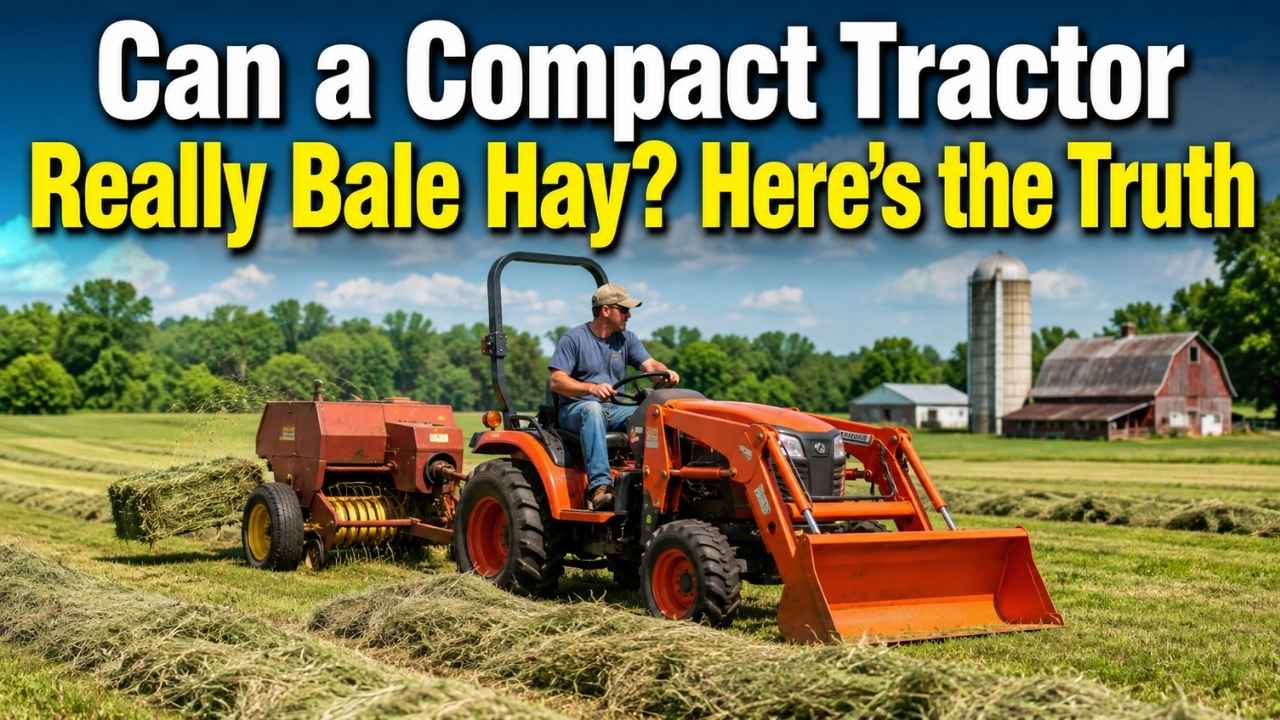
A compact tractor can bale hay, especially if you use traditional hay equipment. Many older farms put up hay for decades with tractors that made only 25 to 30 horsepower at the PTO. Classic small tractors pulled sickle bar mowers, bar rakes, and small square balers long before today’s high-horsepower machines became common.
So, if the question is simply, “Can a compact tractor bale hay?” the answer is yes.
But if the question is, “Is a compact tractor the best tractor for regular hay production?” the answer gets more complicated.
Compact tractors are lighter, smaller, and often equipped with hydrostatic transmissions. That makes them excellent for loader work, mowing, landscaping, driveway maintenance, and general property jobs. Hay production is different. It puts long, steady load on the tractor, often during hot weather, and it usually involves heavy implements working behind you for hours.
That is where a compact tractor starts to show its limits.
How Much PTO Horsepower Do You Need for Hay Equipment?
For small hay production, PTO horsepower matters more than engine horsepower. Hay equipment runs through the PTO, so the number that really counts is the horsepower available at the PTO shaft.
For basic hay work, here is a practical guide:
| Hay Equipment | Minimum PTO Horsepower | Better Choice |
|---|---|---|
| Hay rake | 15–25 PTO HP | 25+ PTO HP |
| Sickle bar mower | 20–30 PTO HP | 30+ PTO HP |
| Small square baler | 25–35 PTO HP | 40+ PTO HP |
| Disc mower | 40–50+ PTO HP | 50–70+ PTO HP |
| Small round baler | 40–50+ PTO HP | 60+ PTO HP |
| Larger round baler | 60+ PTO HP | 70–100+ PTO HP |
For a small square baler and older hay tools, a compact tractor in the 35 to 43 PTO horsepower range may do the job. But if you want to run a disc mower or round baler, you usually need more tractor.
Does Air Conditioning Reduce PTO Horsepower?
Yes, air conditioning can reduce the usable power available from the tractor. The exact amount depends on the tractor, compressor load, engine size, and operating conditions. A common estimate is that running the air conditioning may cost around 5 to 8 horsepower, and in some cases possibly close to 10 horsepower.
For example, if a compact tractor is rated at 43 PTO horsepower, running the air conditioning under load could make it feel closer to a mid-30s PTO horsepower tractor in real field conditions.
That does not mean the tractor suddenly becomes useless. It simply means you have less power margin when pulling hay equipment, especially in thick, wet, heavy grass.
Is 35 PTO Horsepower Enough to Bale Hay?
35 PTO horsepower can be enough to bale hay with the right setup. The best match would be:
- Sickle bar mower
- Light hay rake
- Small square baler
- Flat or gently rolling ground
- Dry hay conditions
- Smaller windrows
- Patient operator
The problem is not always horsepower alone. A small tractor can technically run the baler, but the experience may be rough. A square baler has a plunger that moves back and forth with force. On a lightweight compact tractor, you may feel every plunger stroke through the tractor.
After several hours, that constant movement can wear you out.
A heavier tractor absorbs that motion better. That is one of the biggest reasons many farmers prefer a utility tractor for hay work.
Compact Tractor vs Utility Tractor for Hay Production
The biggest difference between a compact tractor and a utility tractor is not just horsepower. It is weight, frame size, durability, transmission design, and stability.
A compact tractor may have enough PTO horsepower on paper, but it may still feel too light for regular baling. A utility tractor gives you more mass, better stability, and a stronger platform for hay equipment.
| Feature | Compact Tractor | Utility Tractor |
|---|---|---|
| Size | Smaller | Larger |
| Weight | Lighter | Heavier |
| PTO power | Often 25–45 HP | Often 50+ HP |
| Comfort with baler | Can feel rough | More stable |
| Best use | Light hay work, property maintenance | Regular hay production |
| Safety on hills | More caution needed | Usually more planted |
| Long workdays | More tiring | Better suited |
For occasional hay work, a compact tractor can be acceptable. For 30 to 35 acres of hay production every year, a 50 to 70 horsepower utility tractor is usually a better investment.
Hydrostatic Transmission and Hay Baling
Many compact tractors come with hydrostatic transmissions. Hydrostatic tractors are convenient because they are easy to operate, especially for loader work and jobs requiring frequent forward-reverse movement.
However, hay production is a long-duration, high-load job. Baling and mowing hay often happen during the hottest part of the year. Hydrostatic transmissions can build heat under continuous load.
That does not mean a hydrostatic compact tractor cannot bale hay. But if you plan to do it regularly, especially across dozens of acres, a gear transmission tractor may be a more durable and efficient choice.
A gear-drive utility tractor is often preferred for hay work because it transfers power more directly and handles steady pulling jobs better.
Best Tractor Size for 30 to 35 Acres of Hay
For 30 to 35 acres of hay, the minimum practical recommendation is usually a 50 horsepower utility tractor with a gear transmission.
However, if the budget allows, a 70 to 80 horsepower tractor is even better. The extra power and weight give you more flexibility. You can use larger equipment, handle thicker hay, work more comfortably, and reduce strain on the tractor.
A good target range would be:
- Minimum: 50 HP utility tractor
- Better: 60–70 HP tractor
- Best practical used option: 70–85 HP open station tractor
Interestingly, used open-station utility tractors in the 70 horsepower range can sometimes be priced similarly to smaller 50 horsepower tractors. Many hay producers prefer cabs, so open-station tractors may move slower on the used market. That can create buying opportunities.
Sickle Mower vs Disc Mower for Compact Tractors
A sickle mower is easier to run with a smaller tractor because it requires less horsepower than a disc mower. That is why many older low-horsepower tractors were able to cut hay.
But sickle mowers have one big weakness: thick, wet, tangled grass.
In lush spring hay, a sickle mower can plug, gum up, or jam. When that happens, you may have to stop, back up, clean the cutter, and start again. That gets old quickly.
A disc mower handles thick hay much better. It cuts faster and plugs less often. But disc mowers require more horsepower, more weight, and more tractor stability. That is where many compact tractors fall short.
If you have a smaller compact tractor, a sickle mower may be the realistic choice. If you want speed and efficiency, you will probably want a larger utility tractor and disc mower.
Can Any Tractor Pull a Hay Rake?
A hay rake is usually the easiest hay tool to pull. Most compact tractors can handle a hay rake without much trouble. Even small tractors can often rake hay if the ground is not too steep and the rake is properly matched.
If your main job is raking, a compact tractor is usually fine.
The harder jobs are mowing and baling.
Small Square Baler With a Compact Tractor
A small square baler is possible with a compact tractor, but tractor weight matters. The baler’s plunger creates a rhythmic push-pull effect. With a small, light tractor, that motion can rock the machine and fatigue the operator.
For occasional use, this may be tolerable. For long days in the field, it can become uncomfortable.
A heavier utility tractor makes the baler feel smoother and more controlled.
If you plan to use a compact tractor with a small square baler, look for:
- Small older baler
- Lower-capacity windrows
- Flat fields
- Dry hay
- Proper tire ballast
- Safe operating speed
- Good PTO condition
Do not overload the baler just because the tractor can technically turn it.
Should You Buy a Bigger Tractor for Hay Production?
If you already own a compact tractor, you may be able to start with older hay equipment and see how it performs. But if you are planning to invest in hay production seriously, buying a bigger tractor often makes sense.
A 50 horsepower utility tractor is a reasonable minimum. A 70 horsepower open-station tractor may be an even better value if you can find one used.
The best advice is simple: buy the biggest tractor you can afford without overextending your budget.
More tractor gives you:
- Better stability
- More PTO power
- More implement options
- Less operator fatigue
- More safety margin
- Better performance in thick hay
- Less stress on the machine
Can You Bale Hay With a Compact Tractor?
Yes, you can bale hay with a compact tractor, especially with older equipment like a sickle mower, hay rake, and small square baler. A tractor with around 35 PTO horsepower can do more than many people think.
But there is a difference between “possible” and “pleasant.”
For a few acres, a compact tractor may be enough. For 30 to 35 acres of hay, a compact tractor can become slow, tiring, and less efficient. If you want to put up hay every year with fewer headaches, a 50 to 70 horsepower utility tractor is the better choice.
A compact tractor can get the job done. A utility tractor will usually get it done safer, faster, and with a lot less pain.