
Contents
- 1 Quick Comparison: 25 HP vs 50 HP vs 75 HP Tractor
- 2 25 HP Tractor: Best for Hobby Farms and Small Acreage
- 3 25 HP Tractor Real Cost Breakdown
- 4 50 HP Tractor: The Best All-Around Small Farm Size
- 5 50 HP Tractor Real Cost Breakdown
- 6 75 HP Tractor: Best for Serious Farm and Commercial Work
- 7 75 HP Tractor Real Cost Breakdown
- 8 Tractor HP Per Acre Chart
- 9 Do Not Buy Horsepower Only for Acres
- 10 Loader Capacity Matters as Much as Horsepower
- 11 Cab or Open Station: Which Is Better?
- 12 Hydrostatic vs PowerShuttle Transmission
- 13 Which Tractor Size Should You Buy?
- 14 Final Verdict: 25 HP vs 50 HP vs 75 HP
Buying a tractor in 2026 usually starts with one simple question: “How much horsepower do I really need?”
It sounds simple, but horsepower is where many buyers either overspend or end up with a machine that cannot handle their real work. A 25 HP compact tractor may look affordable at first. A 50 HP utility tractor may seem like the safest middle ground. A 75 HP tractor may feel like the professional choice. But the real answer depends less on acreage and more on the heaviest job you expect the tractor to do.
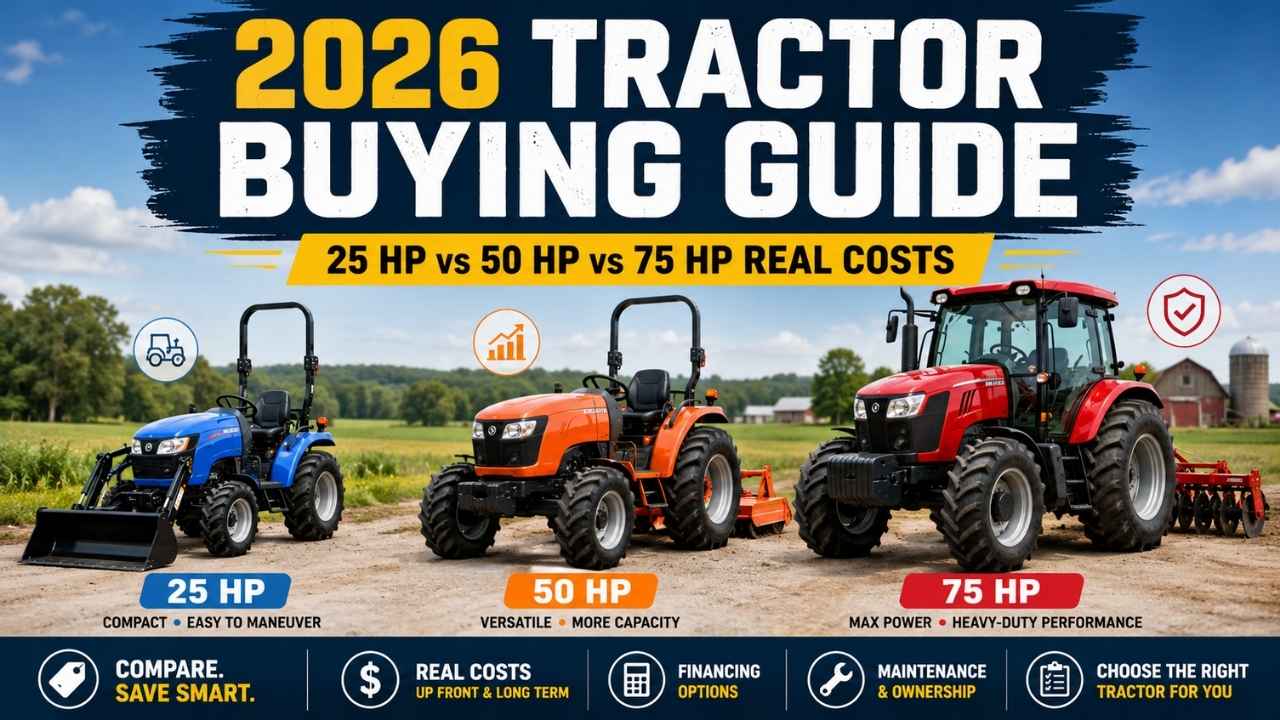
In 2026, a new 25 HP compact tractor may start around $19,000, a 50 HP utility tractor around $35,000, and a 75 HP tractor around $45,000 before loaders, implements, freight, tax, and dealer fees. Once you add the equipment most buyers actually need, the final price difference becomes much more important.
This guide breaks down the real costs, best uses, limitations, and horsepower recommendations for 25 HP vs 50 HP vs 75 HP tractors.
Quick Comparison: 25 HP vs 50 HP vs 75 HP Tractor
| Tractor Size | Best For | Typical Acres | Estimated Full Setup Cost | Main Advantage |
|---|---|---|---|---|
| 25 HP Tractor | Hobby farms, gardens, horse properties | 1–5 acres | About $26,600 | Affordable and easy to maneuver |
| 50 HP Tractor | Small farms, cattle, food plots, hay support | 5–30 acres | About $50,500 | Best all-around size |
| 75 HP Tractor | Professional farm work, hay, commercial jobs | 30–100 acres | About $69,500 | Power, capacity, and productivity |
25 HP Tractor: Best for Hobby Farms and Small Acreage
A 25 HP tractor is usually the entry point for buyers who need more than a lawn mower but do not need a full-size farm tractor. This size is popular with hobby farmers, horse property owners, homesteaders, and landowners managing small acreage.
A 25 HP compact tractor can handle mowing, light loader work, snow removal, driveway maintenance, garden preparation, and small property chores. It is also easier to store, easier to trailer, and easier to operate in tight spaces.
What a 25 HP Tractor Can Do
A 25 HP tractor is a good fit for:
- Mowing small fields
- Pulling a 4-foot rotary cutter
- Running a 4-foot tiller
- Light loader work with a 48-inch bucket
- Snow removal
- Garden and landscaping tasks
- Horse property maintenance
- Small driveway grading
For many buyers with 1 to 5 acres, this size is enough, especially if the tractor will be used under 100 hours per year.
What a 25 HP Tractor Cannot Do Well
The biggest mistake buyers make is expecting a 25 HP tractor to work like a bigger utility tractor. It has limits.
A 25 HP tractor usually is not ideal for:
- Pulling a 6-foot brush hog uphill
- Lifting 2,000 lb round bales
- Running heavy hay equipment
- Pulling a 5-bottom plow
- Handling large-scale field work
- Moving heavy logs safely
If your main job involves heavy lifting, big bales, steep land, or large implements, a 25 HP tractor may feel underpowered very quickly.
25 HP Tractor Real Cost Breakdown
A 25 HP tractor may start around $19,000, but that is rarely the final cost. Most buyers need a loader, a cutter, and must also account for tax, freight, and documentation fees.
| Item | Estimated Cost |
|---|---|
| 25 HP 4WD Tractor | $19,000 |
| Loader | $4,000 |
| 4-Foot Rotary Cutter | $1,600 |
| Tax, Freight, and Doc Fees | $2,000 |
| Estimated Total | $26,600 |
Best Buyer for a 25 HP Tractor
A 25 HP compact tractor is best for someone with a small property, light chores, and no major lifting or hay work. If you mostly mow, maintain a driveway, move mulch, clean stalls, clear snow, or work in a garden, this size can be a smart buy.
For this horsepower range, hydrostatic transmission is often the best choice because it makes loader work, mowing, and back-and-forth chores much easier.
50 HP Tractor: The Best All-Around Small Farm Size
A 50 HP tractor is often considered the “do-everything” size for small farms. It is large enough to run most common 6-foot implements, handle moderate loader work, support food plot work, and manage many cattle or hay-related chores.
For buyers with 5 to 30 acres, a 50 HP tractor is usually the most practical middle ground between affordability and capability.
What a 50 HP Tractor Can Do
A 50 HP tractor can usually handle:
- 6-foot rotary cutters
- 6-foot box blades
- 6-foot tillers
- Small square bales
- 2-row planters
- 8-foot discs
- Food plot preparation
- Pasture maintenance
- General cattle farm chores
- Moderate loader work
This is the size where a tractor starts to feel like a true farm tool rather than a property-maintenance machine.
What a 50 HP Tractor Cannot Do Well
A 50 HP tractor is versatile, but it still has limits. It may struggle with:
- Heavy round bales over 1,500 lbs
- Large hay equipment
- Pulling a 12-foot disc
- Heavy commercial work
- Large-acreage row crop jobs
- Oversized implements
If your work includes big round bales, heavy loader work, or long working days, check loader lift capacity, rear ballast requirements, tractor weight, and hydraulic performance before buying.
50 HP Tractor Real Cost Breakdown
A 50 HP tractor may start around $35,000, but a properly equipped small-farm package can cost much more.
| Item | Estimated Cost |
|---|---|
| 50 HP 4WD Cab Tractor | $35,000 |
| Heavy Loader | $6,500 |
| 6-Foot Cutter, Box Blade, and Tiller Package | $5,500 |
| Tax, Freight, and Doc Fees | $3,500 |
| Estimated Total | $50,500 |
Best Buyer for a 50 HP Tractor
A 50 HP tractor is ideal for landowners who need one machine to do many jobs. It works well for cattle, hay support, food plots, pasture mowing, driveway maintenance, and heavier property chores.
This horsepower range is especially useful for owners who expect to put around 200 to 400 hours per year on the tractor.
If you are unsure whether to buy a 25 HP or 50 HP tractor, ask yourself one question: Will I need 6-foot implements, real loader capacity, or farm-level durability? If yes, the 50 HP tractor is usually the better long-term investment.
75 HP Tractor: Best for Serious Farm and Commercial Work
A 75 HP tractor is for buyers whose tractor is not just a convenience but a working asset. This size is better suited for larger acreage, hay operations, livestock work, commercial jobs, and heavier implements.
For 30 to 100 acres, a 75 HP tractor can save time, reduce strain, and handle jobs that smaller machines cannot perform efficiently.
What a 75 HP Tractor Can Do
A 75 HP tractor can usually handle:
- Round bales
- TMR mixers
- 3-bottom plows
- 10-foot discs
- Larger rotary cutters
- Heavier loader work
- Hay equipment
- Commercial property work
- Larger livestock operations
- More demanding field jobs
The main advantage is not just horsepower. A 75 HP tractor usually offers more tractor weight, better stability, stronger loaders, better hydraulics, larger tires, and more productivity per hour.
What a 75 HP Tractor Cannot Do Well
A 75 HP tractor is powerful, but it is not a large row-crop tractor. It may still be too small for:
- 200+ acre row crop operations
- Large tillage tools
- High-acreage commercial planting
- Heavy multi-bottom plowing
- Big square bale operations
- Large-scale grain farming
If your operation is above 100 acres and depends heavily on row crop work, you may need to look beyond 75 HP.
75 HP Tractor Real Cost Breakdown
A 75 HP tractor has a higher entry cost, but the bigger jump comes when adding a heavy-duty loader and hay equipment.
| Item | Estimated Cost |
|---|---|
| 75 HP 4WD Cab PowerShuttle Tractor | $45,000 |
| Heavy-Duty Loader | $8,000 |
| Hay Equipment Set | $12,000 |
| Tax, Freight, and Doc Fees | $4,500 |
| Estimated Total | $69,500 |
Best Buyer for a 75 HP Tractor
A 75 HP tractor makes sense when your income depends on the machine. If you run hay, cattle, commercial land work, or a serious farm operation, the extra power can pay for itself through time savings and fewer limitations.
This size is best for buyers expecting 400+ hours per year of use.
Tractor HP Per Acre Chart
Acreage can help narrow your options, but it should not be the only factor. Still, this chart gives a useful starting point.
| Acres | Recommended HP | Why |
|---|---|---|
| 1–5 acres | 19–25 HP | Compact size, easy maneuvering, good for light chores |
| 5–20 acres | 25–40 HP | Better for 5-foot implements and heavier property work |
| 20–50 acres | 40–60 HP | Haying, food plots, and heavier field work start here |
| 50–100 acres | 60–85 HP | More acres require more speed, power, and efficiency |
| 100+ acres | 85+ HP | Larger operations need bigger tractors and financing-level planning |
Do Not Buy Horsepower Only for Acres
One of the most common tractor buying mistakes is choosing horsepower based only on acreage. Acreage matters, but your heaviest job matters more.
For example, a buyer with 5 acres may still need more than 25 HP if they plan to lift heavy logs, move large round bales, or work on steep terrain. On the other hand, someone with 50 acres who only mows open land a few times per year may not need a 75 HP tractor.
The better rule is simple:
Buy horsepower for your heaviest job, not just your acreage.
Loader Capacity Matters as Much as Horsepower
Many buyers focus on engine horsepower but forget about loader lift capacity. This is especially important if you plan to move bales, logs, pallets, gravel, manure, or feed.
A tractor may have enough horsepower to drive around your property but still lack the weight and loader capacity to safely lift what you need. For heavy loader work, always compare:
- Loader lift capacity
- Lift height
- Tractor operating weight
- Rear ballast requirements
- Hydraulic flow
- Front axle strength
- Tire size and stability
If lifting is your main job, a heavier tractor with a stronger loader may be more important than simply buying the cheapest horsepower.
Cab or Open Station: Which Is Better?
A cab tractor costs more, but it can be worth it if you work in extreme weather, mow dusty fields, clear snow, or spend long hours in the seat.
Choose an open station tractor if you want a lower price, easier entry and exit, and simpler maintenance. Choose a cab tractor if you need heat, air conditioning, dust protection, and better comfort during long workdays.
For 25 HP tractors, many buyers stay open station. For 50 HP and 75 HP tractors, a cab becomes much more attractive, especially for hay, cattle, snow, and commercial use.
Hydrostatic vs PowerShuttle Transmission
Transmission choice also depends on the work.
A hydrostatic transmission is excellent for mowing, loader work, snow removal, and property maintenance. It is easy to operate and ideal for frequent direction changes.
A PowerShuttle transmission is better suited for heavier farm work, loader use, pulling implements, and long working hours. It is common on larger utility tractors like 75 HP models.
For a 25 HP tractor, hydrostatic is often the best choice. For a 50 HP tractor, either hydrostatic or shuttle can work depending on the job. For a 75 HP tractor, PowerShuttle is usually the more serious farm-oriented option.
Which Tractor Size Should You Buy?
Buy a 25 HP tractor if:
You have 1 to 5 acres, mostly mow, maintain a garden, clear snow, do light loader work, and use the tractor fewer than 100 hours per year.
Buy a 50 HP tractor if:
You have 5 to 30 acres, need 6-foot implements, manage food plots, handle cattle chores, move small bales, and want one tractor that can do a little of everything.
Buy a 75 HP tractor if:
You have 30 to 100 acres, handle round bales, run hay equipment, do commercial work, or depend on the tractor for income.
Final Verdict: 25 HP vs 50 HP vs 75 HP
The best tractor horsepower depends on your real workload. A 25 HP compact tractor is affordable and practical for small properties, but it reaches its limits quickly with heavy implements or lifting jobs. A 50 HP utility tractor is the best all-around choice for many small farms because it can run common 6-foot implements and handle a wider range of jobs. A 75 HP tractor is the right move when time, lifting power, hay work, and productivity matter.
Do not buy the biggest tractor just because it looks better on paper. Also, do not buy the smallest tractor just because it saves money upfront. The wrong tractor can cost more in wasted time, extra repairs, unsafe lifting, and jobs you still cannot complete.
The smartest buying rule is this:
Match the tractor to your heaviest job first, then check your acreage, budget, implements, and yearly hours.