
Contents
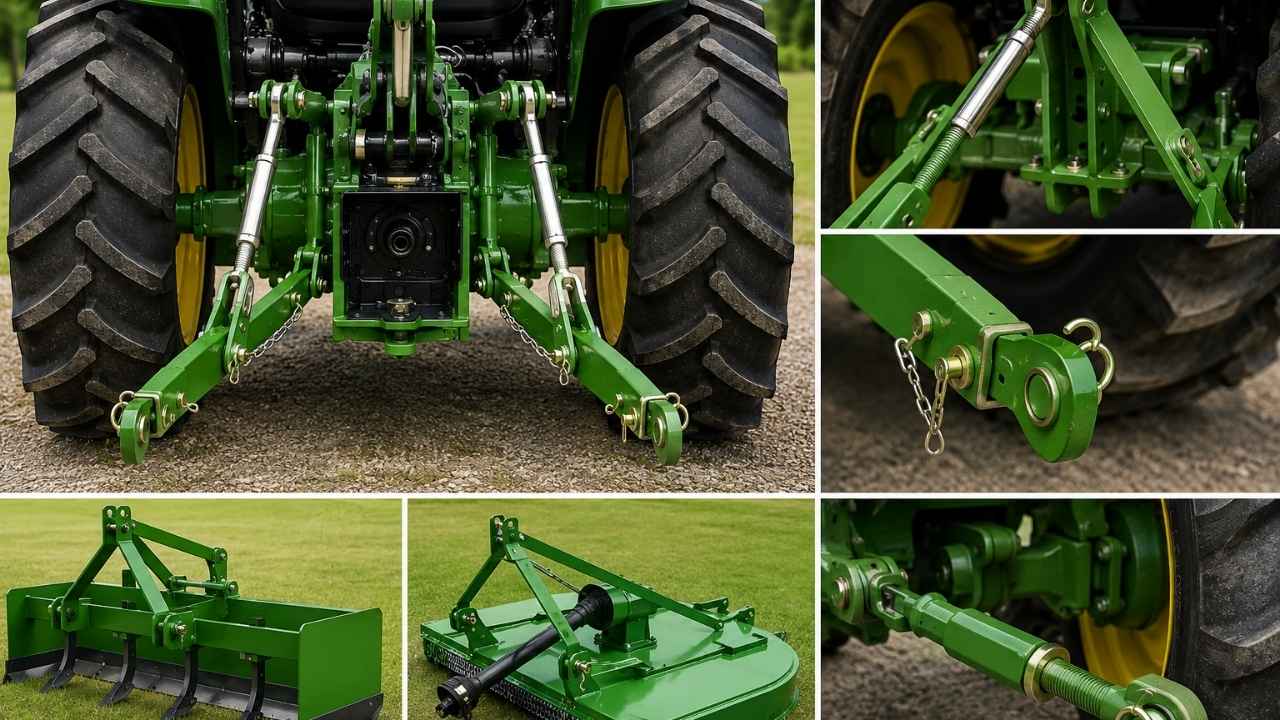
A 3-point hitch is the rear linkage system on many tractors that allows the operator to attach, lift, lower, and control implements such as box blades, rotary cutters, rear blades, tillers, plows, and landscape rakes. The main parts of a tractor 3-point hitch include:
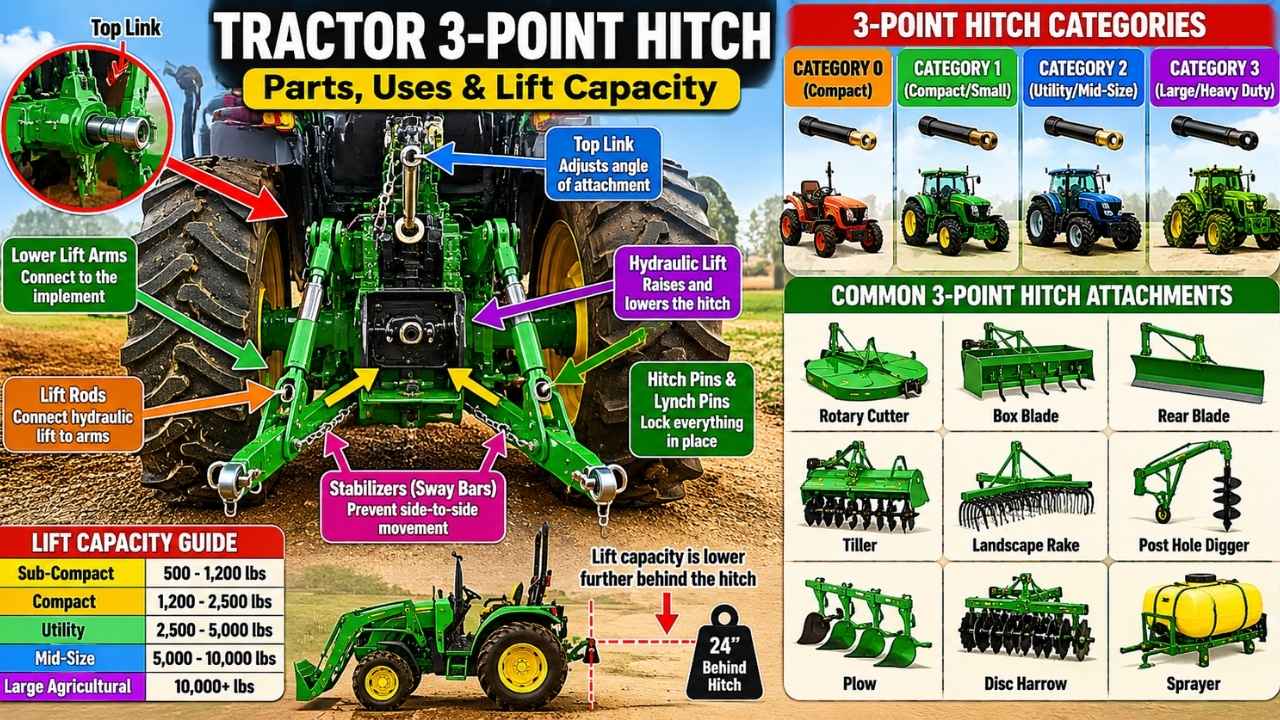
- Lower Lift Arms: The lower lift arms are the two main arms at the bottom of the hitch. They connect to the lower mounting points of the attachment. These arms carry most of the implement’s weight and allow the tractor to lift and lower the equipment.
- Top Link: The top link is the adjustable upper arm that connects the tractor to the top mounting point of the implement. It controls the angle or pitch of the attachment. For example, adjusting the top link can change how aggressively a box blade cuts into the ground.
- Lift Rods: The lift rods connect the hydraulic lift mechanism to the lower arms. When the tractor’s hydraulic system raises or lowers, the lift rods move the lower arms up or down.
- Stabilizers or Sway Chains: Stabilizers, sway bars, or sway chains help prevent the implement from swinging too far side to side. This is important when using attachments like mowers, blades, or tillers because too much movement can make the equipment harder to control.
- Hydraulic Lift System: The tractor’s hydraulic system powers the hitch. It allows the operator to raise, lower, and hold the attachment at a desired height.
- Draft Control and Position Control: Some tractors include draft control and position control. Position control lets the operator set and hold the implement at a specific height. Draft control is mostly used with ground-engaging tools like plows. It automatically adjusts the hitch depending on soil resistance.
- Hitch Pins and Lynch Pins: The implement connects to the hitch using hitch pins, while lynch pins or retaining clips keep everything locked in place.
Are All Tractor 3-Point Hitches the Same?
No, not all tractor 3-point hitches are the same. They work on the same basic principle, but they come in different categories based on tractor size, horsepower, pin diameter, and lift capacity.
The most common 3-point hitch categories are:
| Hitch Category | Common Tractor Type | Typical Use |
|---|---|---|
| Category 0 | Garden tractors, small compact tractors | Light-duty attachments |
| Category 1 | Compact and small utility tractors | Mowers, blades, tillers, small implements |
| Category 2 | Utility and mid-size farm tractors | Heavier cutters, plows, discs, larger implements |
| Category 3 | Larger agricultural tractors | Heavy-duty farm equipment |
| Category 4 | Very large tractors | Large commercial farming implements |
The key differences are usually:
- Pin size
- Arm spacing
- Lift capacity
- Implement size
- Tractor horsepower compatibility
For example, a Category 1 attachment will not always fit directly onto a Category 2 hitch without bushings or adapters. Some tractors also use quick hitches, which make attachment changes faster, but the implement must be compatible with that quick hitch system.
So, while the basic design is similar, the size and capacity can be very different.
What Is a 3-Point Hitch Attachment?
A 3-point hitch attachment is any implement designed to connect to the tractor using the three hitch points: two lower connection points and one upper top-link connection.
Common 3-point hitch attachments include:
- Rotary cutters
- Box blades
- Rear blades
- Landscape rakes
- Tillers
- Post hole diggers
- Disc harrows
- Plows
- Subsoilers
- Seeders
- Finish mowers
- Carry-all platforms
- Sprayers
- Fertilizer spreaders
- Back blades
- Grading scrapers
The main advantage of a 3-point hitch attachment is that the tractor can lift it, carry it, lower it into working position, and control its angle or depth.
For example, a 3-point box blade can be used for driveway grading, while a 3-point rotary cutter can be used to cut tall grass and brush. A 3-point tiller is commonly used for garden preparation, soil mixing, and small farm work.
How to Add a 3-Point Hitch to a Tractor?
Adding a 3-point hitch to a tractor depends on the tractor model. Some tractors already have a factory 3-point hitch, while others may need a conversion kit or aftermarket hitch system.
Here is the general process:
Check Tractor Compatibility
Before buying anything, confirm whether your tractor can accept a 3-point hitch. You need to know the tractor’s:
- Model number
- Horsepower
- Rear frame design
- Hydraulic capability
- PTO availability, if using powered attachments
- Hitch category needed
Older tractors, garden tractors, and some industrial tractors may not come with a standard 3-point hitch.
Choose the Correct Hitch Kit
Many tractors have aftermarket 3-point hitch kits available. These kits may include lower lift arms, top link bracket, lift links, stabilizers, pins, and mounting hardware.
Make sure the kit matches your tractor model. A universal kit may require fabrication, welding, drilling, or hydraulic modifications.
Confirm Hydraulic Lift Capability
A 3-point hitch needs a way to raise and lower the attachment. Some tractors already have rear hydraulic lift capability. Others may need an added hydraulic cylinder, control valve, pump connection, or mechanical lift setup.
Install the Hitch Components
Typical installation includes:
- Mounting the lower lift arm brackets
- Installing the lift arms
- Adding the top link bracket
- Connecting lift rods or hydraulic lift arms
- Installing stabilizers or sway chains
- Securing everything with proper pins and bolts
Test the Hitch Without an Implement
After installation, raise and lower the hitch without any attachment first. Check for binding, rubbing, weak mounting points, uneven arm movement, or hydraulic leaks.
Attach a Light Implement First
Start with a lighter attachment before using heavier equipment. This helps confirm that the hitch works safely and that the tractor can handle the load.
Important Safety Note
Do not exceed the tractor’s lift capacity or modify the frame in a way that weakens the machine. A poorly installed 3-point hitch can damage the tractor or create a serious safety risk.
How Much Weight Can a Tractor 3-Point Hitch Lift?
The lift capacity of a tractor 3-point hitch depends on the tractor size, hitch category, hydraulic system, and where the weight is measured.
In general:
| Tractor Type | Approximate 3-Point Hitch Lift Capacity |
|---|---|
| Sub-compact tractor | 500–1,200 lbs |
| Compact tractor | 1,200–2,500 lbs |
| Utility tractor | 2,500–5,000 lbs |
| Mid-size farm tractor | 5,000–10,000 lbs |
| Large agricultural tractor | 10,000+ lbs |
However, these are general estimates. The exact number depends on the tractor model.
One important detail is that manufacturers may list lift capacity in different ways:
Lift Capacity at the Ball Ends
This is the lifting power measured directly at the lower arm ends. It is usually the higher number.
Lift Capacity 24 Inches Behind the Ball Ends
This is measured farther back, where the weight of many real attachments actually sits. This number is usually lower and often more realistic.
For example, a tractor may lift 2,500 pounds at the hitch points, but only 1,800 pounds at 24 inches behind the hitch.
Other Factors That Affect Lift Capacity
The actual safe lifting ability depends on:
- Tractor weight
- Hydraulic strength
- Rear ballast
- Front ballast
- Tire traction
- Implement length
- Weight distribution
- Terrain slope
- Hitch category
- Tractor stability
A tractor may technically lift a heavy attachment but still become unsafe if the front end gets light. Front weights or a front loader may be needed for balance.
A tractor 3-point hitch is a rear-mounted linkage system made of two lower lift arms, a top link, lift rods, stabilizers, pins, and a hydraulic lift system. Not all 3-point hitches are the same because they come in different categories, sizes, and lift capacities.
A 3-point hitch attachment is any implement that connects to those three mounting points, such as a box blade, tiller, mower, plow, or rake. A 3-point hitch can sometimes be added to a tractor with the right kit, but the tractor must have the proper frame, hydraulics, and capacity.
As for lifting power, small tractors may lift around 500 to 1,200 pounds, while larger farm tractors can lift several thousand pounds or more. Always check the tractor’s official lift rating before using heavy 3-point implements.