
Contents
A tractor listed at 25 horsepower does not send 25 horsepower to your rear mower. If you have ever wondered why a mower rated for “20 PTO hp” bogs down behind your 25 hp tractor, this is the reason.
A quick honest note: I’m not writing this from a barn full of tractors. I got here by reading spec sheets, owner’s manuals and a lot of owner forum threads, and the same confusion kept popping up. Engine horsepower and PTO horsepower get mixed up constantly. So let’s sort it out properly.
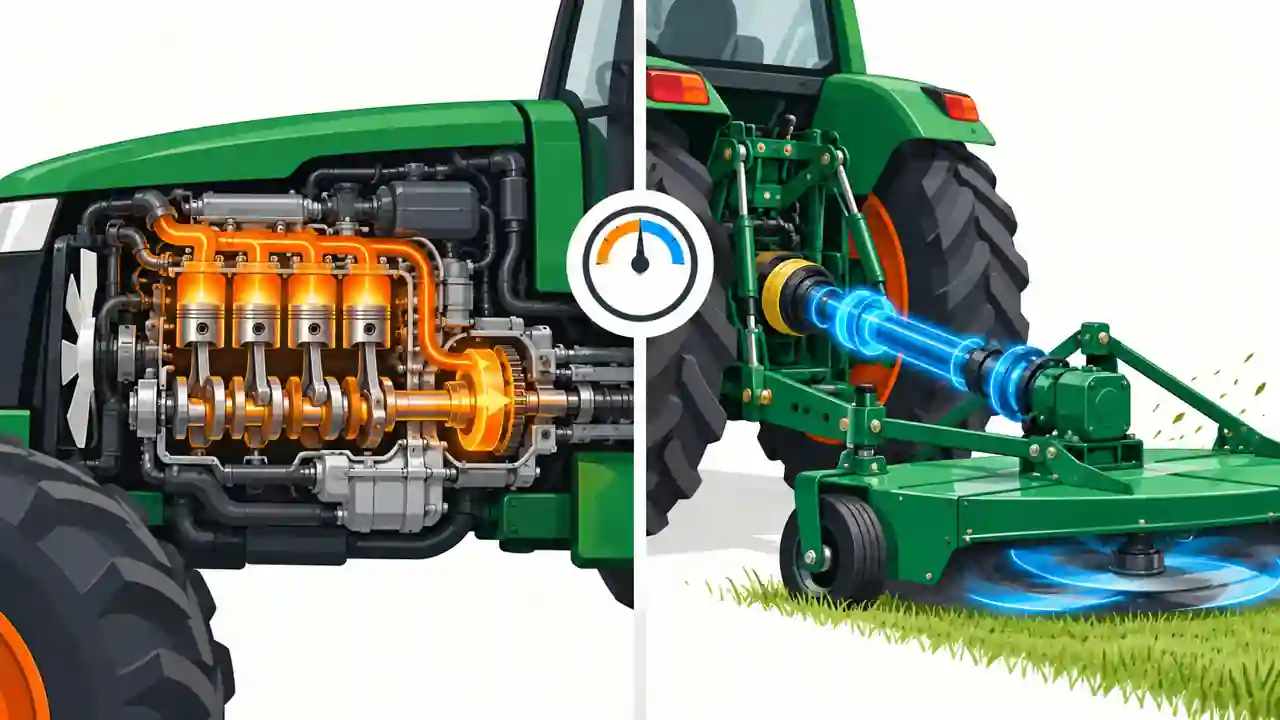
Engine horsepower is measured at the engine itself. PTO horsepower is measured at the power take-off shaft, after the drivetrain, hydraulic pump and friction have taken their share. PTO power is always lower. Most sources put the gap somewhere between 10 and 20 percent, and sometimes more.
When you shop for an implement, the PTO number is the one that matters.
Why the numbers don’t match
US manufacturers mostly advertise engine horsepower. It is the bigger number, so it looks better on the brochure. But your attachments never touch the crankshaft. Power has to travel through the clutch, gears or hydrostatic pump, and the PTO shaft first, and some of it is lost as heat on the way.
Transmission type changes the size of the loss:
- Gear-drive tractors lose the least, often around 10 percent.
- Hydrostatic tractors lose more. The hydro pump keeps running and soaking up power even when you are standing still, so 20 percent or higher is not unusual.
Treat those as rough ranges, not promises. The exact figure depends on the model.
A real example
Kubota spec sheets show the gap clearly. One 72 hp rated model delivers about 61 hp at the PTO. That is roughly a 15 percent drop, and it is a perfectly normal result for a modern diesel tractor.
Let’s do the math. Say you’re looking at a 25 hp tractor and the roughly 10 to 20 percent loss range applies. That leaves you with about 20 to 22.5 PTO horsepower. Now say the chipper you like asks for 20 PTO hp minimum. On paper it fits, but you’d be running at the very edge. A 30 hp tractor with the same loss lands around 24 to 27 PTO hp. That’s the one that won’t scream at you all afternoon.
How to find your tractor’s actual PTO horsepower
- Look at the spec sheet. Most manufacturers list both engine and PTO horsepower. If only one number is listed, assume it is engine hp.
- Check the operator’s manual. It often has the PTO figure even when the brochure doesn’t.
- Look for a Nebraska Tractor Test report. Many larger tractors have been independently tested. Many compacts haven’t, so don’t be surprised if you find nothing.
- Ask the dealer to put it in writing. If they can’t give you a PTO number, that tells you something too.
What this means when buying implements
Every PTO-driven attachment lists a minimum PTO horsepower requirement. Match that number against your tractor’s PTO rating, not its engine rating.
I covered this in the wood chipper guide. A subcompact with 15 to 20 PTO horsepower can run a 3.5 to 4 inch chipper, but it will struggle with anything bigger, whatever the brochure says. The same logic applies to the flail mower and to any rotary cutter you pull through thick grass.
A few practical points:
- Leave some margin. If an implement needs 18 PTO hp, a tractor with exactly 18 will run flat out all day. Aim for a bit more.
- Wet or dense material makes it worse. Rated requirements assume decent conditions. Thick, damp growth takes more power than the spec implies.
- An older tractor loses a little power over the years. Expect the real number to be at or below the original rating.
Common mistakes
Comparing engine hp across brands. One maker’s 30 hp tractor might have better PTO output than another’s 33 hp tractor. Compare PTO numbers when you can find them.
Assuming more horsepower is always better. For loader work and pulling, engine torque and weight matter as much as horsepower. PTO horsepower is mainly about running implements.
Ignoring PTO speed. Most compact tractors run a 540 rpm PTO. Make sure the implement matches.
Engine horsepower tells you how strong the engine is. PTO horsepower tells you what your attachments will get. Before buying a mower, chipper or any other PTO implement, find your tractor’s PTO rating, compare it to the requirement, and leave yourself some margin.
Your turn. What tractor are you running, and have you ever found its real PTO number? Drop the model in the comments. If you can’t find it, tell me what you’re looking at and we’ll dig through it together.
If you are still choosing a tractor, check how it handles the work you actually plan to do. Bush hogging a 10-acre field takes a very different amount of power than trimming a small lawn.