Contents
- 1 What Is a Land Plane?
- 2 What Is a Box Blade?
- 3 Land Plane vs Box Blade for Gravel Driveways
- 4 Which Is Better for an Existing Gravel Driveway?
- 5 Why Is a Land Plane Easier to Use?
- 6 Land Plane or Box Blade for Potholes?
- 7 Which Is Better for Washboard?
- 8 Which Attachment Works Better on a Hard-Packed Driveway?
- 9 Land Plane vs Box Blade for Building a Crown
- 10 Can a 25 HP Tractor Pull a Land Plane?
- 11 Can a 25 HP Tractor Pull a Box Blade?
- 12 How Wide Should the Attachment Be?
- 13 Does Moisture Make Gravel Easier to Grade?
- 14 Which Should You Buy First?
- 15 Do You Need Both a Land Plane and Box Blade?
- 16 Check the Driveway Before You Start Grading
- 17 Need Gravel Driveway Tractor Work Near You?
If you are comparing a land plane vs box blade for a gravel driveway, the right choice depends less on the attachment itself and more on the condition of the road.
For an established driveway that mainly needs regular smoothing, a land plane is usually the easier tool to use. It works especially well for redistributing loose gravel, knocking down high spots and reducing washboard.
A box blade becomes more useful when the driveway needs heavier repair. If you have compacted material that must be ripped up, gravel that needs to be moved from one section to another, or a road profile that needs to be reshaped, the box blade gives the operator more control.
That leads to a simple rule of thumb:
- Choose a land plane for routine gravel-road maintenance.
- Choose a box blade for heavier repair, reshaping and material movement.
- If you maintain a long rural driveway and regularly deal with both situations, owning both attachments can make sense.
What Is a Land Plane?
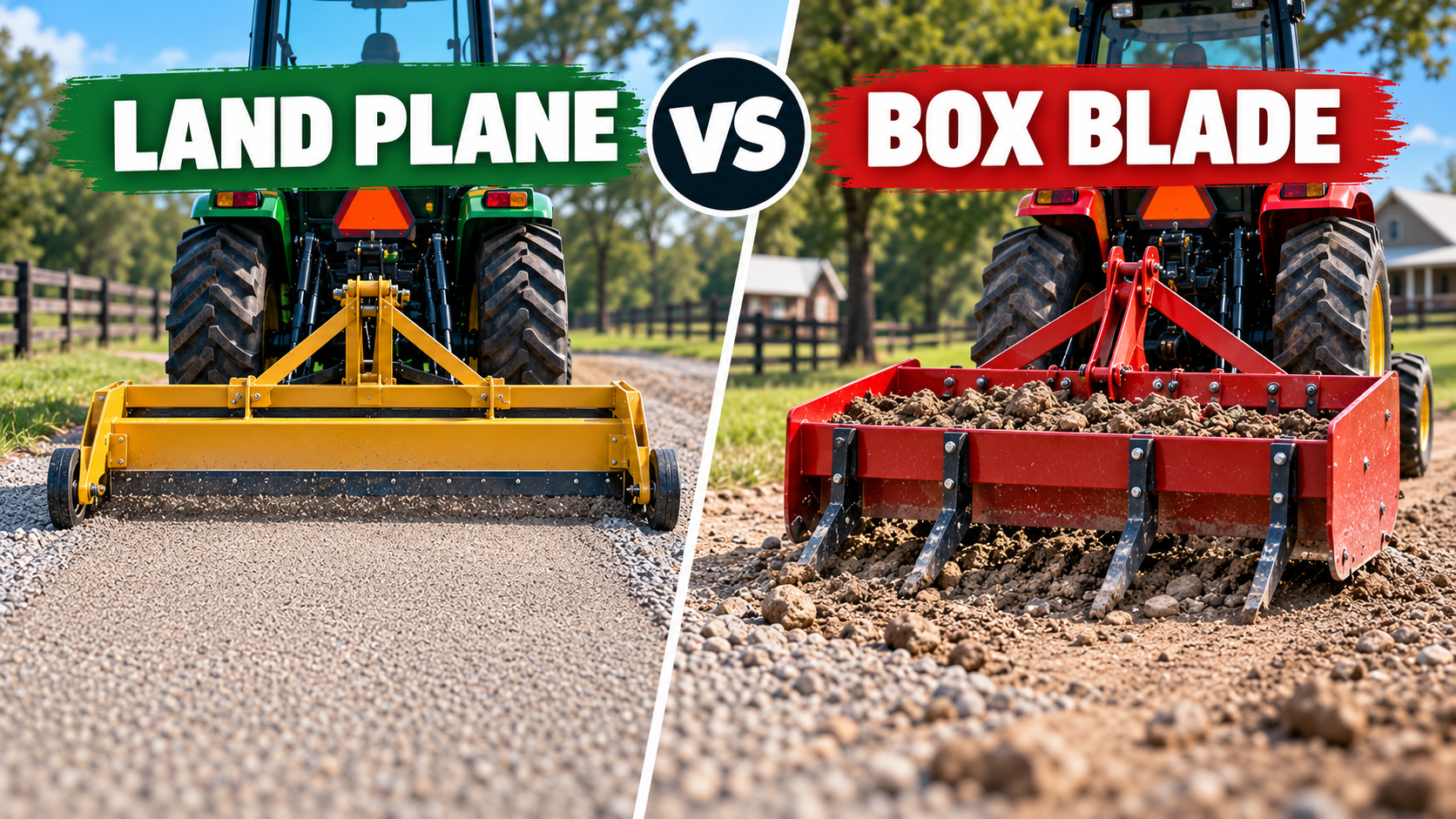
A land plane, often sold as a grading scraper, is a 3-point tractor attachment designed to smooth and redistribute material rather than carry large amounts of it.
The typical design uses long side rails with cutting blades positioned between them. As the tractor moves forward, the blades shave material from high spots. Loose gravel remains inside the working area briefly before being released into lower sections of the driveway.
The long frame is important. It allows the attachment to bridge smaller dips instead of simply following every rise and depression in the road.
That is one reason land planes are popular with tractor owners who do not have a great deal of grading experience.
Some models also include scarifier teeth. These can be lowered to loosen harder material before the grading blades make subsequent passes.
For an owner whose main job is maintaining an existing gravel driveway, this simple operating behavior is one of the land plane’s biggest advantages.
What Is a Box Blade?
A box blade is also mounted on the tractor’s 3-point hitch, but it is designed to do a broader range of dirt and gravel work.
The attachment normally includes:
- Two side plates that help contain material.
- Front and rear cutting edges.
- Adjustable scarifier or ripper teeth.
- A box-shaped body capable of collecting and moving gravel or soil.
Because material can accumulate inside the box, the operator can remove gravel from one area and release it somewhere else.
That makes a box blade useful for much more than smoothing.
It can be used to rip compacted surfaces, fill depressions, move material, backfill an area and reshape sections of a driveway.
The tradeoff is that it takes more practice to operate well.
A box blade responds quickly to changes in tractor pitch and 3-point-hitch position. An inexperienced operator can sometimes create new waves and dips while trying to remove the old ones.
Land Plane vs Box Blade for Gravel Driveways
The easiest way to compare the two attachments is by the work you actually need to perform.
| Driveway Job | Land Plane | Box Blade |
|---|---|---|
| Routine driveway maintenance | Excellent | Good |
| Light to moderate washboard | Excellent | Good |
| Redistributing loose gravel | Excellent | Very good |
| Easy operation for beginners | Excellent | Moderate learning curve |
| Breaking compacted gravel | Good if equipped with scarifiers | Excellent |
| Deep pothole repair | Limited to moderate | Better |
| Moving gravel between areas | Limited | Excellent |
| Major driveway reshaping | Limited | Excellent |
| Backfilling | Limited | Excellent |
| General property grading | Good | More versatile |
Neither attachment wins every category.
The land plane is the more specialized maintenance tool. The box blade is the more versatile grading tool.
Which Is Better for an Existing Gravel Driveway?
If your driveway already has a reasonably solid base and acceptable shape, the land plane is usually the better maintenance attachment.
This is especially true when the main problems are:
- Small surface irregularities.
- Loose gravel moving toward the edges.
- Shallow low spots.
- Light or moderate washboard.
- General roughness caused by normal traffic.
Instead of collecting a large amount of gravel, the land plane continuously redistributes material as you drive.
That makes it well suited to periodic maintenance.
A driveway that receives a few maintenance passes before it becomes badly deteriorated may never require the more aggressive work a box blade can provide.
Why Is a Land Plane Easier to Use?
Three-point grading can be frustrating because the attachment follows the tractor.
Imagine the front wheels climbing over a high spot. That changes the angle of the tractor and therefore the position of the rear attachment. When the wheels drop into a depression, the opposite happens.
With a box blade, the operator may need to keep adjusting the 3-point hitch to compensate.
A land plane’s longer side rails help reduce this effect. Instead of reacting as strongly to every small change in terrain, the implement tends to bridge imperfections and gradually level them.,
For someone learning how to maintain a gravel driveway, that can make a major difference.
You can generally make repeated passes and allow the attachment to work gradually rather than constantly adjusting the hitch.
Land Plane or Box Blade for Potholes?
Potholes are where the comparison becomes more complicted.
A shallow depression in loose gravel may disappear after several passes with a land plane. The attachment can pull material from nearby high areas and redistribute it across the damaged section.
A deep or recurring pothole is different.
If you simply drag fresh gravel over a hole without disturbing the compacted material around and underneath it, the repair may only be temporary.
A more serious pothole may require several steps:
- Break up the compacted material around the damaged area.
- Remove or loosen material below the bottom of the hole.
- Redistribute or add suitable aggregate.
- Restore the proper driveway profile.
- Correct any drainage problem that caused the failure.
For this type of repair, a box blade with scarifiers often has the advantage because it can aggressively loosen and move material.
A land plane with scarifiers may also work, but the job begins to move away from routine maintenance and toward reconstruction.
Which Is Better for Washboard?
For ordinary gravel driveway washboard, the land plane is usually the first attachment I would choose.
Washboard creates a repeating series of small ridges and depressions. A land plane’s long frame and grading blades are well suited to cutting the tops of those ridges and gradually moving loose aggregate into the lower sections.
Several passes may be necessary.
The goal should not be to remove a large amount of gravel in one aggressive pass. A better approach is to make controlled passes until the surface begins to level.
If the washboard has become extremely hard and compacted, however, the surface may need to be scarified before it can be properly reshaped.
At that point, either a land plane equipped with scarifiers or a box blade may be appropriate.
Which Attachment Works Better on a Hard-Packed Driveway?
A hard-packed driveway changes the job because the cutting edges may simply ride over the surface instead of loosening it.
Scarifiers become important.
A box blade with ripper teeth allows the operator to lower the scarifiers and break through the compacted layer. After the material has been loosened, the teeth can be raised and the blade used to redistribute the gravel.
Some land planes also offer scarifiers, which makes them much more capable on compacted roads.
The difference is what happens afterward.
If you mainly need to loosen the surface and then smooth it, a scarifier-equipped land plane may do everything you need.
If you need to loosen material and then move significant quantities of it from one section to another, the box blade remains the more versatile choice.
Land Plane vs Box Blade for Building a Crown
A gravel driveway needs to shed water.
If the road surface allows water to sit in low areas or travel straight down the wheel tracks, potholes and erosion can return regardless of how often the driveway is graded.
Many gravel roads therefore use a crown or another form of cross slope to move water toward the sides.
If the driveway already has a good shape and you simply want to maintain it, a land plane can work well.
If the crown has disappeared or the road needs to be substantially reshaped, a box blade usually gives the operator more control.
With the tractor’s 3-point hitch properly adjusted, the box blade can be angled to move more material toward a particular side.
That makes it more useful when you are creating road geometry rather than merely smoothing an existing surface.
Can a 25 HP Tractor Pull a Land Plane?
A 25 HP tractor can operate many compact land planes, but horsepower should not be the only factor used to select one.
You also need to consider:
- Tractor weight.
- 3-point hitch lift capacity.
- Implement weight.
- Working width.
- Tire traction.
- Driveway slope.
- Gravel condition.
- Whether scarifiers will be used.
A tractor may have enough engine power to pull an atachment over loose gravel yet struggle when the scarifiers are lowered into a heavily compacted road.
Traction is often the limiting factor.
This is why buying the widest land plane your tractor can physically lift is not always the best strategy.
Can a 25 HP Tractor Pull a Box Blade?
Yes, many box blades are designed for compact tractors in this horsepower range.
Again, however, the number printed on the tractor’s hood does not tell the entire story.
A box blade becomes much harder to pull when it fills with gravel.
Dropping the scarifiers into compacted material increases resistance even further.
A light compact tractor may therefore have enough horsepower but not enough weight and traction to fully use a large, heavy box blade.
The attachment should be matched to the tractor manufacturer’s recommendations as well as the box blade manufacturer’s specifications.
How Wide Should the Attachment Be?
For driveway grading, the attachment is often wide enough to cover the tractor’s rear tire tracks.
That does not mean wider is always better.
A wider land plane or box blade covers more ground with every pass, but it also creates more resistance.
A smaller implement can be easier to control when:
- The driveway is steep.
- Gravel is heavily compacted.
- Scarifiers are being used.
- The tractor is relatively light.
- Material is wet or difficult to move.
- The driveway contains tight turns or narrow sections.
Use manufacturer compatibility recommendations as the starting point rather than selecting width based only on driveway size.
Does Moisture Make Gravel Easier to Grade?
Usually, some moisture can make driveway material easier to work.
A road that is extremely dry and hard may resist the cutting edges and scarifiers.
At the other extreme, a saturated driveway can lose structural strength and become muddy under the tractor.
The ideal condition depends on the aggregate, soil and drainage, but many operators prefer working after enough moisture has entered the surface to loosen the material without leaving it saturated.
If the tractor tires are sinking or creating deep ruts, it is probably not the right time to grade.
Which Should You Buy First?
If the overwhelming majority of your work will be maintaining an existing gravel driveway, start with a land plane.
It is simpler to operate and particularly well suited to routine surface maintenance.
Choose a box blade first if you expect to do a wider variety of tractor work, including moving dirt, backfilling, ripping hard ground or reshaping areas around the property.
Think about the decision this way:
Choose a land plane if you mainly want to maintain.
Choose a box blade if you mainly need to repair, reshape and move material.
For a badly neglected driveway, the best long-term setup may actually be both. Use the box blade when the road needs major repair, then use the land plane periodically so it does not return to that condition.
Do You Need Both a Land Plane and Box Blade?
Not everyone does.
Someone maintaining a short residential gravel driveway may be perfectly satisfied with a land plane alone.
A property owner maintaining a long private road, however, is more likely to encounter situations where both tools are useful.
The box blade can handle the occasional major repair. The land plane can handle the more frequent maintenance passes.
That combination also reduces the temptation to use one attachment for jobs it was never particularly good at.
Check the Driveway Before You Start Grading
Before hooking up either attachment, inspect the driveway itself.
Do not look only at the potholes.
Try to determine why the damage appeared.
Pay particular attention to:
- Standing water after rain.
- Water flowing down the wheel tracks.
- Blocked or damaged culverts.
- Poor roadside drainage.
- Gravel pushed toward the road edges.
- Sections where the crown has disappeared.
- Soft spots in the base.
- Areas where runoff enters from adjacent land.
If water is causing the problem, grading alone may only hide it temporarily.
A smooth driveway with poor drainage will eventually become a rough driveway again.
Need Gravel Driveway Tractor Work Near You?
You do not necessarily need to buy another attachment to fix a gravel driveway.
For a long road, major pothole repair or driveway reconstruction, hiring an experienced tractor operator may be more economical than purchasing equipment you will rarely use.
When requesting a quote, provide enough information for the operator to understand the job before arriving.
Include:
- Approximate driveway length and width.
- Several current photos.
- Type of surface material.
- Size and depth of potholes.
- Severity of washboard.
- Known drainage problems.
- Steep sections or difficult access.
- Whether additional gravel needs to be delivered or spread.
You can use our Local Tractor Work Near Me directory to look for tractor services that handle driveway grading and related property work.