
Contents
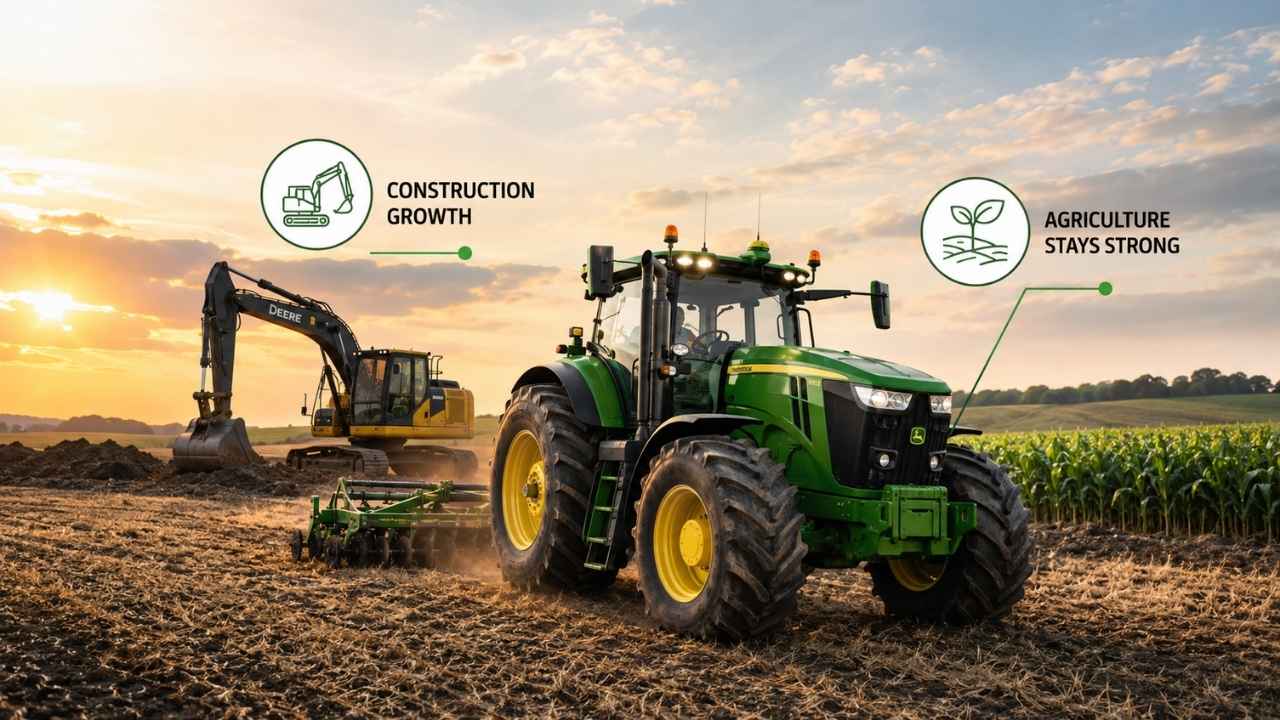
John Deere reports stronger construction and forestry sales while farmers continue to delay equipment purchases due to weak margins, higher input costs and uncertain commodity markets.
John Deere is finding support from its construction and forestry business at a time when the farm machinery market remains under pressure. While the company continues to see demand for construction equipment improve, many farmers are still cautious about buying new tractors, combines and high-horsepower machines.
The latest results show a split picture for Deere & Co. On one side, construction activity helped lift sales in a key segment. On the other, the agricultural equipment market remains weighed down by weak farm income, high operating costs and uncertainty in global crop demand. Farm Progress reported that Deere kept its full-year profit outlook unchanged after posting fiscal second-quarter earnings that beat market expectations.
Farm Machinery Demand Remains Soft
The main challenge for Deere is still the slowdown in large agricultural equipment. Farmers have been dealing with several difficult market conditions at once: lower profitability, higher production expenses, volatile commodity prices and rising costs for fuel and fertilizer.
Because of that, many growers are delaying major equipment purchases. New tractors, combines, planters and other big-ticket implements are expensive investments, and farmers usually become more conservative when margins tighten.
Deere’s production and precision agriculture segment, which includes many of its larger farm machines, saw net sales fall 14% in the fiscal second quarter, according to the report. The company also continues to expect sales in the U.S. and Canada to be down 15% to 20% for the year.
Construction and Forestry Help Offset Weakness
The brighter spot for Deere came from construction and forestry. This side of the business benefited from stronger shipment volumes and better pricing. Demand for construction machinery has been supported by broader infrastructure activity and expanding construction needs, including projects connected to data centers and AI-related development.
Deere reported that second-quarter sales in construction and forestry were 29% higher than the same period a year earlier. Small agriculture and turf also improved, rising 16%. These gains helped balance some of the weakness in the farm equipment market.
For Deere, this matters because the company is not relying only on row-crop tractors and combines. Its construction, forestry, turf and smaller equipment divisions can provide support when the farm economy slows.
Farmers Still Need Stronger Profits Before Big Equipment Sales Recover
Even though Deere’s earnings beat expectations, the outlook for farm equipment is still cautious. Analysts noted that farmers may need to see a meaningful improvement in profitability before demand for high-horsepower tractors and combines picks up again.
That is especially true for large equipment. A farmer may continue repairing an older machine instead of replacing it if grain prices are uncertain and input costs are high. Diesel, fertilizer, interest rates and machinery financing all influence buying decisions.
This creates a difficult environment for companies like Deere. Farmers still need reliable equipment, but they may postpone purchases until their balance sheets improve.
South American Outlook Gets Weaker
The report also noted a weaker outlook for South America. Deere now expects sales in the region to fall 15%, compared with an earlier expectation of only a 5% decline. This is important because Brazil and other South American markets are major agricultural equipment buyers.
One concern is that Brazilian growers may be more exposed to current spot prices for inputs as they prepare for the next planting cycle. Higher fertilizer and fuel costs can quickly reduce confidence and delay machinery investment.
Deere Keeps Profit Outlook Steady
Despite the mixed market, Deere maintained its annual net income forecast of $4.5 billion to $5 billion. The company’s fiscal second-quarter net income came in at $1.77 billion, above the reported estimate of $1.54 billion.
That result shows Deere is still profitable and operationally strong, even as the farm equipment cycle remains weak. However, investors reacted cautiously because the recovery in agriculture machinery demand still appears uncertain.
Why This Matters for Farmers and Equipment Buyers
For farmers, the story is simple: machinery prices remain high, but farm margins are tight. That combination makes equipment decisions more difficult. A new tractor or combine may improve efficiency, but the cost has to make sense in a year when crop prices, fuel, fertilizer and interest rates remain unpredictable.
For equipment dealers, this could mean more demand for used machinery, parts, repairs and service work. When farmers delay buying new machines, they often invest more in keeping older equipment running.
For Deere, the construction side of the business gives the company some breathing room. But a stronger recovery in agriculture will likely require better farmer profitability, more confidence in crop demand and relief from input cost pressure.
John Deere’s latest results show two very different equipment markets. Construction and forestry are helping the company grow, while large farm machinery continues to struggle. Farmers are still cautious, and many are waiting for better market conditions before making major equipment purchases.
Deere remains one of the strongest names in agricultural and construction machinery, but the farm equipment recovery may take more time. Until commodity prices, input costs and farmer confidence improve, demand for big tractors and combines could remain under pressure.