Contents
- 1 Why Kubota 3 Cylinder Diesel Engines Are So Common?
- 2 Kubota D722: The Small Engine with a Big Reputation
- 3 Kubota D902 and D905: Compact, Useful, and Often Confused
- 4 Kubota D1005: A Strong Middle-Ground Option
- 5 Kubota D1105: One of the Most Recognized 3 Cylinder Models
- 6 Kubota D1305 and D1503: Bigger 3 Cylinder Diesel Choices
- 7 Quick Comparison of Common Kubota 3 Cylinder Diesel Models
- 8 How to Identify the Right Kubota 3 Cylinder Diesel Engine
- 9 Are Kubota 3 Cylinder Diesel Engines Reliable?
- 10 Buying a Used Kubota 3 Cylinder Diesel Engine
- 11 Can You Swap Kubota 3 Cylinder Engines?
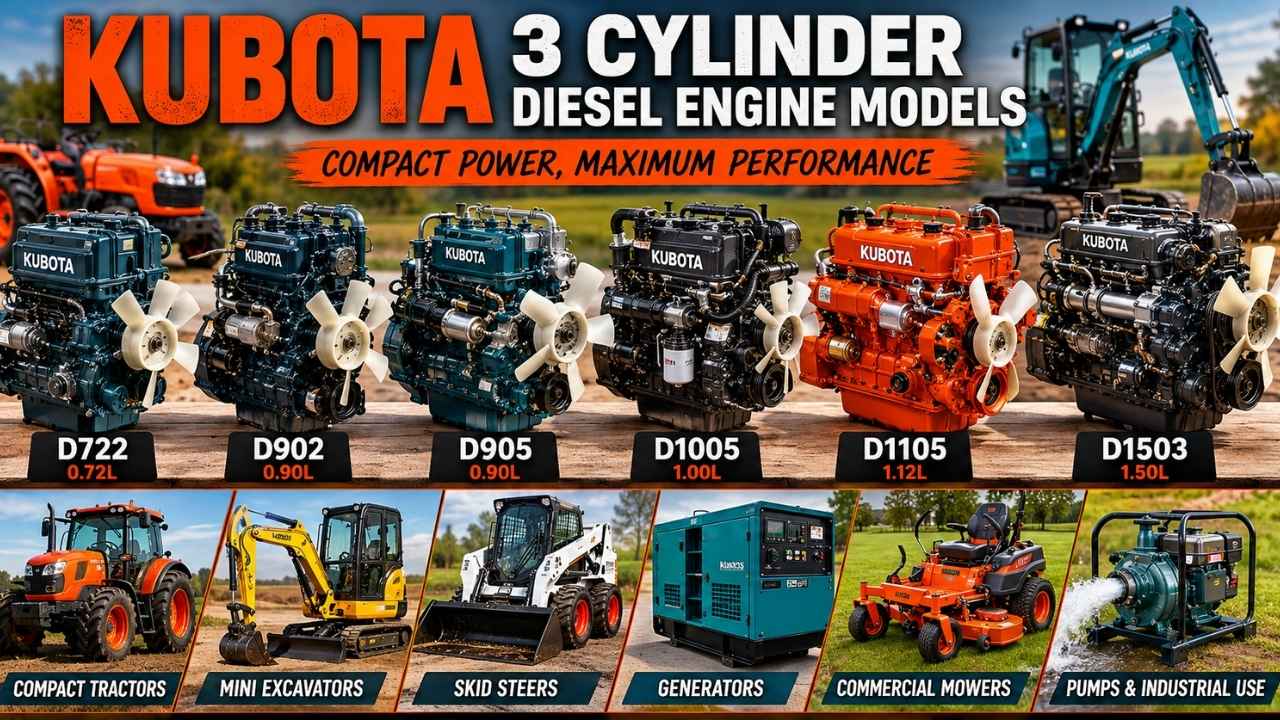
Kubota 3 cylinder diesel engine models include well-known engines such as the D722, D902, D905, D1005, D1105, D1305, and D1503. These compact diesel engines are commonly used in tractors, generators, mini excavators, commercial mowers, skid steers, pumps, and industrial equipment.
The main reason they are so popular is simple: they offer reliable power in a small package. However, not every Kubota 3-cylinder engine is the same. Displacement, horsepower range, mounting setup, emissions version, and parts compatibility can change from one model to another, so identifying the exact engine model is important before buying parts or a replacement engine.
That is exactly why engines like the Kubota D722, D902, D905, D1005, D1105, D1305, and D1503 are searched so often. Some people are trying to identify the engine in an older tractor. Some are looking for a replacement motor. Others need parts, rebuild kits, filters, injectors, glow plugs, or a used engine that will actually fit their machine. The problem is that “Kubota 3 cylinder diesel engine” is a broad term. It sounds specific, but it covers several different models with different sizes, power ranges, and applications.
A D722 and a D1503 may both be 3-cylinder Kubota diesel engines, but they are not the same kind of engine. One is commonly associated with smaller equipment and tight engine compartments, while the other belongs in a stronger class of compact industrial power. That difference matters when you are buying parts, comparing used engines, or thinking about an engine swap.
Why Kubota 3 Cylinder Diesel Engines Are So Common?
Kubota built a strong reputation in the compact diesel market because its engines offer a practical balance. They are small enough to fit into compact equipment, but strong enough to handle long working hours. In many machines, space is limited. A manufacturer needs an engine that can deliver useful torque without making the machine too heavy, too expensive, or too difficult to service. That is where Kubota’s 3-cylinder diesel engines became a very popular choice.
These engines are especially common in compact tractors, small construction machines, diesel generators, commercial mowers, pumps, and utility vehicles. They are also used by many equipment brands outside Kubota. That is why you may open the hood of a machine that is not branded Kubota and still find a Kubota diesel engine inside.
The appeal is not only about size. Kubota 3-cylinder diesels are known for steady operation, fuel efficiency, parts availability, and long service life when maintained correctly. They are not magic engines, of course. Bad fuel, overheating, poor maintenance, dirty oil, and neglected filters can damage any diesel. But when cared for properly, these engines often become the kind of powerplant people trust for years.
Kubota D722: The Small Engine with a Big Reputation
The Kubota D722 is one of the best-known small Kubota 3-cylinder diesel engines. It is often found in compact equipment, diesel generators, commercial mowing equipment, small utility vehicles, and light industrial machines. This engine became popular because it is compact, simple, and dependable.
For equipment owners, the D722 makes sense in machines where space is tight and fuel economy matters. It is not designed to be the strongest engine in the Kubota lineup, but that is not its job. Its job is to provide reliable power in smaller applications. That is why it appears so often in generators and compact machines that need to run steadily without taking up much room.
If you are buying parts for a D722, the model number alone is not always enough. Different versions can have different accessories, electrical setups, injection components, flywheel housings, oil pans, or cooling arrangements. The safest move is always to check the engine tag and serial number before ordering.
Kubota D902 and D905: Compact, Useful, and Often Confused
The Kubota D902 and Kubota D905 are often discussed together because they sit in a similar small diesel category. Both are 3-cylinder engines, both are used in compact equipment, and both have strong parts support. Still, they should not be treated as automatically interchangeable.
The D902 is commonly seen in generators, mini equipment, utility machines, and compact industrial applications. It gives a little more strength than the smallest Kubota diesels while still staying compact. For many machines, that makes it a sweet spot.
The D905 is also widely used and remains common in the parts and replacement engine market. You may find it in turf equipment, compact tractors, generators, and small industrial machines. Because these engines look similar to other Kubota D-series engines, buyers sometimes make the mistake of assuming that a part from one model will fit another. That can become expensive quickly.
When comparing D902 vs D905, always look beyond the name. Check the full engine code, serial number, emissions version, mounting setup, and accessories. Two engines can look almost identical in a photo but still require different parts.
Kubota D1005: A Strong Middle-Ground Option
The Kubota D1005 is a step up from the smaller engines and is often used where a machine needs more working power without moving into a much larger engine platform. You may see it in compact tractors, commercial mowers, loaders, industrial equipment, and small construction machines.
This engine is popular because it feels like a practical middle-ground choice. It is not oversized for compact equipment, but it has more displacement and working ability than smaller options such as the D722. For machines that run long hours or handle heavier work, that extra capacity can make a real difference.
The D1005 is also a model where application details matter. A D1005 used in a tractor may not be set up exactly like a D1005 used in a generator or industrial power unit. The base engine family may be the same, but the surrounding components can change depending on the equipment manufacturer.
Kubota D1105: One of the Most Recognized 3 Cylinder Models
The Kubota D1105 is probably one of the most familiar Kubota 3-cylinder diesel engine models. It appears in compact tractors, mini excavators, skid steers, generators, welders, hydraulic power units, and industrial machines. Because it is so widely used, it is also one of the models people often search for when looking for used engines or replacement parts.
The D1105 has a reputation for being versatile. It is small enough for compact equipment, but strong enough for serious work. That is why it became a popular choice in many machines that need reliable diesel power without stepping into a larger 4-cylinder engine.
However, the D1105 also shows why engine identification is so important. Not every D1105 is set up the same way. Some versions may have different emissions equipment, different manifolds, different injection system details, or different accessory layouts. If you are replacing a D1105, do not buy only by model name. Match the important details before spending money.
Kubota D1305 and D1503: Bigger 3 Cylinder Diesel Choices
The Kubota D1305 and Kubota D1503 belong to the larger side of Kubota’s 3-cylinder diesel engine range. These engines are usually found in machines that need more torque and more displacement than the smaller D-series models can provide.
The D1305 may appear in industrial equipment, larger compact tractors, construction machines, and stationary power applications. It is not always as commonly discussed as the D722 or D1105, but it is still an important model for equipment owners dealing with heavier compact machines.
The D1503 is even stronger within the 3-cylinder category. It is often used in heavier compact equipment, generators, industrial machines, hydraulic systems, and construction-related applications. If someone says they need a Kubota 3-cylinder diesel engine, the difference between a D722 and a D1503 is huge. One is suited to smaller equipment; the other is built for more demanding work.
That is why it is dangerous to shop by cylinder count alone. Three cylinders only tells you the basic layout. It does not tell you displacement, power range, physical fitment, emissions setup, or accessory compatibility.
Quick Comparison of Common Kubota 3 Cylinder Diesel Models
| Engine Model | General Position | Typical Use |
|---|---|---|
| Kubota D722 | Small 3-cylinder diesel | Generators, mowers, compact utility equipment |
| Kubota D902 | Small to mid-size 3-cylinder diesel | Mini equipment, generators, utility machines |
| Kubota D905 | Small to mid-size 3-cylinder diesel | Turf equipment, compact tractors, generators |
| Kubota D1005 | Mid-size 3-cylinder diesel | Compact tractors, loaders, industrial equipment |
| Kubota D1105 | Popular mid-size 3-cylinder diesel | Tractors, skid steers, mini excavators, generators |
| Kubota D1305 | Larger 3-cylinder diesel | Construction and industrial applications |
| Kubota D1503 | Stronger 3-cylinder diesel | Heavy compact equipment and power units |
This comparison is useful as a starting point, but it should not replace the engine tag, parts manual, or machine-specific information. Kubota engines can vary depending on the equipment they were installed in.
How to Identify the Right Kubota 3 Cylinder Diesel Engine
If you are trying to identify your engine, start with the tag or stamped number on the engine block. The model number tells you the engine family, while the serial number helps narrow down production details and parts compatibility. This is especially important when ordering internal parts, fuel system parts, electrical components, gaskets, or cooling system parts.
Photos can help, but they can also mislead you. Many Kubota 3-cylinder diesel engines look similar from the outside. A seller may list an engine as “Kubota 3 cylinder diesel” without knowing the exact model. That may be fine for casual browsing, but it is not enough for a real purchase.
You should also pay attention to the machine the engine came from. An engine removed from a generator may not be ready to drop into a tractor. The oil pan, bellhousing, flywheel, mounts, throttle linkage, exhaust, intake, and wiring may be different. Even when the basic engine block is compatible, the swap can require extra work.
Are Kubota 3 Cylinder Diesel Engines Reliable?
Kubota 3-cylinder diesel engines are generally considered reliable, but reliability depends heavily on maintenance. A well-maintained engine can run for many years. A neglected one can become a headache no matter how good the brand is.
Most problems come from familiar causes: dirty fuel, clogged filters, overheating, weak batteries, bad glow plugs, worn injectors, low compression, or poor cooling system maintenance. Hard starting does not always mean the engine is worn out. Sometimes the issue is as simple as air in the fuel system, a weak battery, or failed glow plugs.
Smoke can also tell part of the story. White smoke during cold start may point toward fuel or compression issues, while black smoke under load may suggest too much fuel, restricted air, injector problems, or an overloaded engine. Still, diagnosis matters. Guessing and replacing parts blindly can waste money fast.
Buying a Used Kubota 3 Cylinder Diesel Engine
A used Kubota diesel engine can be a smart buy, especially when a new replacement is too expensive. But used engines need careful checking. A clean coat of paint does not prove an engine is healthy.
Before buying, ask for the full model number, serial number, clear photos of the engine tag, and a video of the engine starting cold. A warm-start video is less useful because many tired diesel engines start better once they are already warm. If possible, ask for compression information, oil pressure details, and proof that the engine ran under load.
Be cautious with engines that have missing tags, unknown hours, milky oil, heavy blow-by, cracked castings, overheating signs, or no return policy. A cheap engine can become expensive if it needs a rebuild immediately after installation.
Can You Swap Kubota 3 Cylinder Engines?
Kubota engine swaps are possible, but they are not always simple. Many people assume that one Kubota D-series engine can replace another because the engines look similar. In reality, the swap depends on the machine, the bellhousing, mounts, flywheel, oil pan, exhaust routing, radiator connections, wiring, throttle setup, and hydraulic or PTO connections.
For example, replacing a D1105 with another D1105 from a different application may still require changing external parts. Swapping from a D905 to a D1105 or from a D722 to a larger model can involve even more fitment problems. The engine may physically fit, but that does not mean everything will line up.
The safest approach is to match the exact engine model and application whenever possible. If that is not possible, compare every major mounting and accessory point before buying.
Kubota 3 cylinder diesel engine models have earned their popularity because they are practical, efficient, and dependable. Engines like the D722, D902, D905, D1005, D1105, D1305, and D1503 power far more machines than many people realize. They show up in tractors, generators, mowers, mini excavators, skid steers, pumps, and industrial equipment because they offer a useful mix of compact size and real working ability.
The key is not just knowing that the engine has three cylinders. The key is knowing exactly which Kubota model you have, how it is configured, and what machine it came from. That information can save you from ordering the wrong parts, buying the wrong used engine, or starting a swap that becomes more complicated than expected.
If you are shopping for parts or a replacement engine, start with the engine tag, confirm the serial number, and compare the setup carefully. A Kubota 3-cylinder diesel can be a long-lasting workhorse, but only when the right engine is matched to the right machine.