
Contents
Searching for a used tractor near me is often the fastest way to find a machine that fits your budget, land, and workload. It can also be one of the easiest ways to buy someone else’s expensive repair problem.
A used tractor does not need to look new to be a good purchase. What matters is whether it starts reliably, works safely, matches the implements you need, and has enough local parts and service support. Before you put money down, take the time to inspect the machine, compare similar listings, and calculate the full cost of getting it home.
Start With the Work, Not the Brand
The first question is not “Which tractor brand should I buy?” It is “What jobs will this tractor actually do?”
Write down the heaviest and most frequent tasks before you search. For example:
- Mowing pasture or brush
- Moving dirt, gravel, feed, or firewood
- Maintaining a driveway
- Tilling a garden or food plot
- Handling hay or livestock chores
- Clearing snow
- Using a post-hole digger, box blade, or rotary cutter
A small compact tractor can be excellent for mowing, light loader work, and property maintenance. It may not be the right choice for large round bales, steep ground, or heavy field work.
Horsepower matters, but it is not the only number that matters. Loader lift capacity, tractor weight, PTO horsepower, tire condition, and hydraulic performance can be just as important.
Where to Look for Used Tractors Near You
A local search gives you one major advantage: you can inspect the tractor before buying it.
Good places to search include:
- Local tractor dealerships
- Farm equipment dealers with used inventory
- Agricultural equipment auctions
- Farm and ranch classified listings
- Local Facebook Marketplace and Craigslist listings
- Tractor salvage yards and equipment recyclers
- Estate, retirement, or farm liquidation auctions
Dealers usually charge more than a private seller, but they may offer service records, financing, trade-in options, and help with transport. Private listings can offer better prices, but the buyer needs to inspect the machine more carefully.
If you need help finding a reputable seller, read our guide to tractor dealers near me.
Check the Hour Meter, but Do Not Trust It Alone
Hours are useful, but they are only one part of the story.
A well-maintained tractor with 3,000 honest hours can be a better buy than a neglected machine showing 900 hours. Look at the overall condition and ask whether the wear matches the number shown on the meter.
Pay attention to:
- Pedal wear
- Seat condition
- Steering-wheel wear
- Loader-pin looseness
- Three-point hitch wear
- Worn controls and switches
- Tire age and cracking
- Signs that the hour meter was replaced or stopped working
If a low-hour tractor looks heavily used, ask questions. A seller should be able to explain the machine’s history clearly.
Used Tractor Inspection Checklist
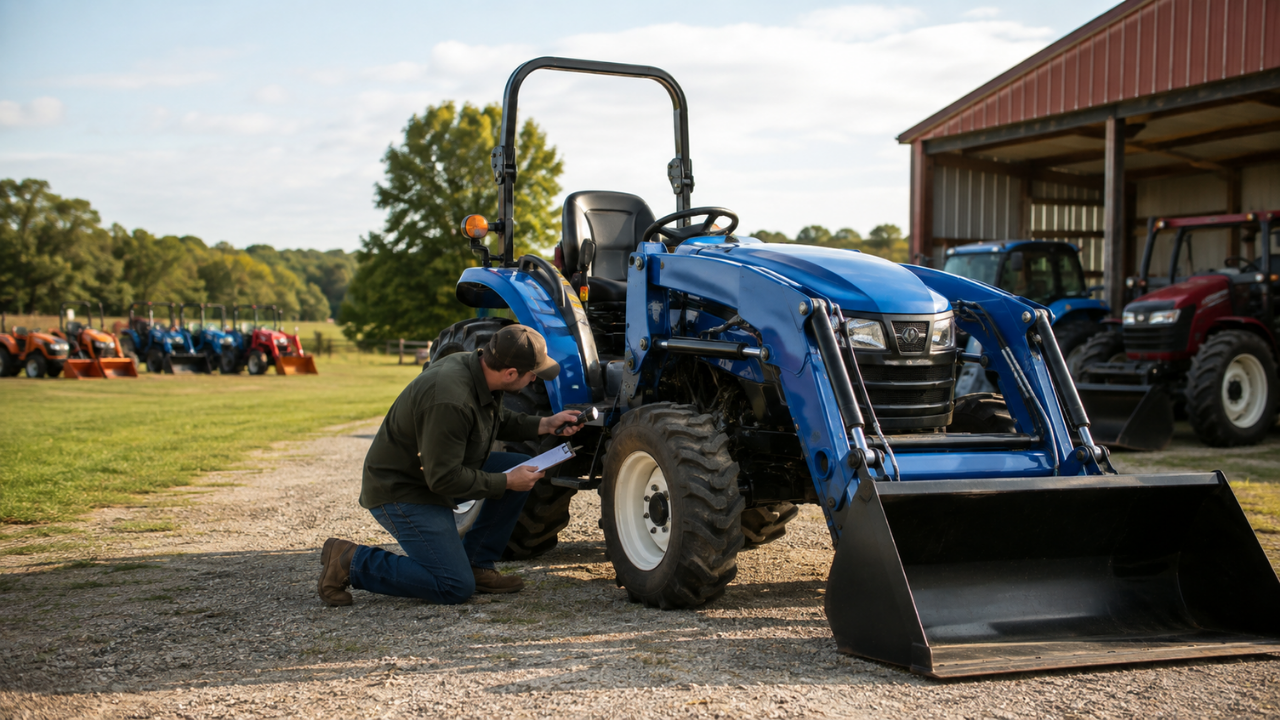
Never buy a used tractor based on photos alone. See it in person whenever possible, preferably when the engine is cold.
1. Check the Engine at Cold Start
Ask the seller not to warm up the tractor before you arrive. A cold start can reveal problems that are hidden once the engine is running.
Watch for:
- Excessive white, blue, or black smoke
- Hard starting
- Knocking or unusual engine noise
- Oil leaks around the engine
- Coolant leaks
- Blow-by coming from the breather
- Warning lights that stay on
A little diesel smoke on startup can be normal. Continuous heavy smoke, rough running, or loud knocking deserves a closer inspection by a qualified mechanic.
2. Test the Transmission and Four-Wheel Drive
Drive the tractor in every available gear or range. If it has hydrostatic transmission, test forward and reverse under load.
Look for:
- Hesitation when moving
- Grinding during gear changes
- A tractor that creeps when it should be stopped
- Weak pulling power
- Four-wheel drive that will not engage or disengage correctly
- Unusual whining or vibration
Transmission repairs are expensive. Do not assume a shifting problem is a simple adjustment.
3. Test the Loader and Hydraulics
If the tractor has a front-end loader, raise, lower, curl, and dump the bucket several times.
Check for:
- Hydraulic leaks
- Jerky movement
- Slow lifting
- Bent loader arms
- Loose pins or bushings
- Weld repairs or cracks
- Cylinders that drift down while holding a load
Hydraulic oil should not look milky. Milky oil can indicate water contamination, while a burnt smell can suggest overheating or internal wear.
4. Inspect the PTO and Three-Point Hitch
The PTO and three-point hitch are essential if you plan to run implements.
Test the PTO at the correct speed and make sure it engages smoothly. Inspect the hitch arms, stabilizers, lift links, and top-link bracket for cracks, excessive wear, or poor weld repairs.
Ask the seller which implements they used with the tractor. A machine that spent years running an oversized rotary cutter or heavy loader may have more wear than its appearance suggests.
5. Look Closely at Tires and Rims
Tires are not a small expense. A “cheap” used tractor can become costly quickly if all four tires need replacement.
Check for:
- Deep cracks in the sidewalls
- Dry rot
- Uneven wear
- Fluid leaks from loaded tires
- Damaged rims
- Mismatched tire sizes
- Weak tread for the terrain you work on
Also make sure the tires suit your needs. Turf tires, R4 industrial tires, and agricultural R1 tires all behave differently in mud, pasture, snow, and loader work.
Ask for Service Records and the Serial Number
A serious seller should be willing to provide basic history.
Ask for:
- Service receipts
- Recent repair invoices
- Owner’s manual
- Serial number
- Known problems
- Reason for selling
- Whether there is a loan or lien on the machine
- Included implements, loaders, weights, or attachments
Use the serial number to confirm the model and approximate production year. It also helps when checking parts availability.
Local dealer support matters. A great tractor is less useful if parts are difficult to find or there is no nearby service option.
Calculate the Real Cost Before You Buy
The listing price is not the final cost.
Before making an offer, add:
- Sales tax, if applicable
- Transport or trailer rental
- Immediate repairs
- Tires
- Filters, fluids, and batteries
- Missing implements
- Insurance
- Financing costs
- New safety equipment or lights
A used tractor that costs $18,000 can become a $24,000 purchase after hauling, repairs, and attachments. Compare the complete cost with a newer machine or a dealer-backed option before deciding.
Do Not Skip the Safety Check
Look for a sound ROPS, or rollover protective structure. Do not buy a tractor with a cut, bent, badly rusted, or poorly repaired ROPS.
Make sure the seatbelt works and that safety switches, brakes, lights, and the parking brake function correctly. If you will operate on hills, stability and safe braking matter more than cosmetic paint condition.
The best used tractor is not always the lowest-priced tractor in your area. It is the machine that has been maintained, inspected, sized correctly for your work, and supported by available parts and service.
Take your time, inspect it cold, test every major function, and walk away from any seller who will not let you examine the tractor properly.
A used tractor can save thousands of dollars compared with buying new. The key is buying the right machine—not simply buying the closest one.