Contents
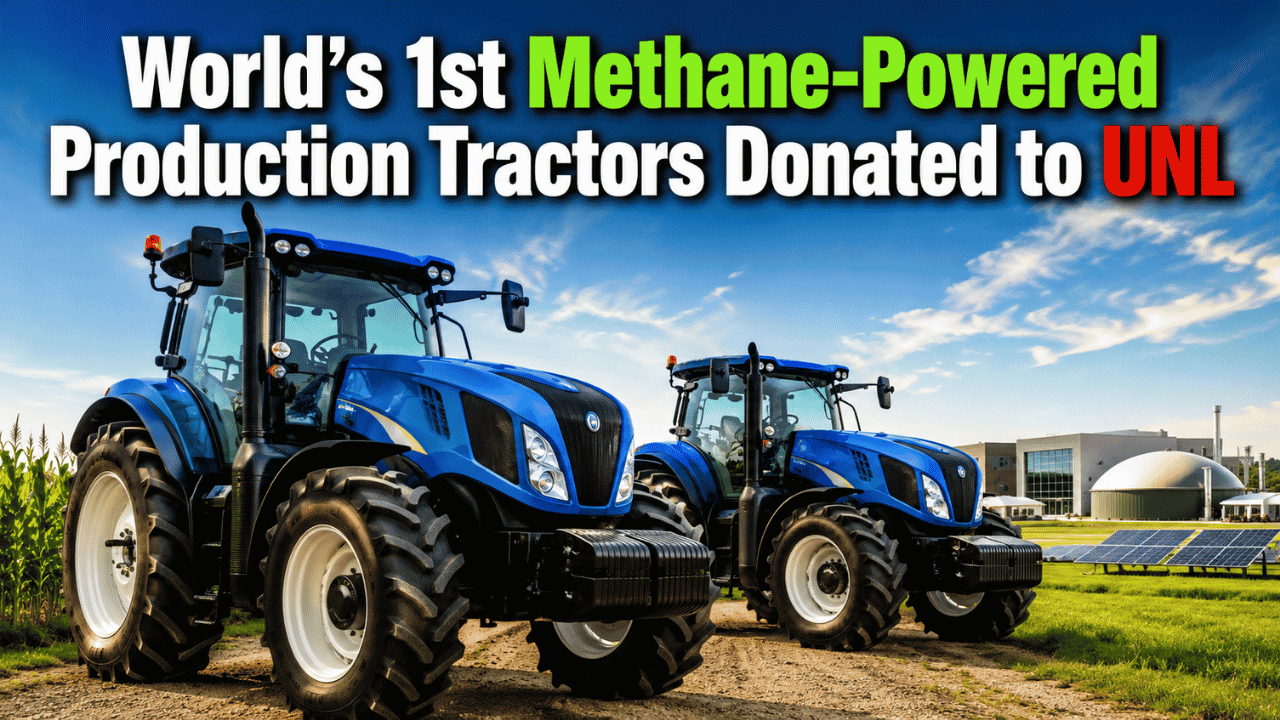
The University of Nebraska’s Eastern Nebraska Research, Extension and Education Center near Mead has added two highly unusual tractors to its research fleet: New Holland T6.180 methane-powered machines donated by CNH. These tractors are not just new equipment for fieldwork. They represent a major step toward cleaner, farm-based energy use and give students, researchers, and producers a real-world look at how alternative fuels may fit into modern agriculture.
The donated tractors are described as the world’s first methane-powered production tractors. Each New Holland T6.180 carries a retail value of $287,240, making the gift a significant investment in agricultural research and education. The donation was supported by Andy Dozler, manufacturing engineering manager at CNH’s Grand Island plant and a University of Nebraska-Lincoln graduate.
Why These Methane-Powered Tractors Matter?
The biggest difference between these tractors and a traditional diesel tractor is the fuel source. The New Holland T6.180 methane tractor can run on upgraded biomethane, renewable natural gas and conventional compressed natural gas. That flexibility makes the machine especially interesting for farms, municipalities and large facilities that already have access to natural gas systems or renewable fuel sources.
For livestock farms, especially dairy operations, the concept becomes even more practical. A farm with an anaerobic digester can turn manure and other agricultural waste into biogas. After purification through an upgrading system, that biomethane can fuel the tractor. In simple terms, farm waste can help power farm equipment. That creates a circular waste-to-energy model that reduces dependence on diesel and gives producers another way to use resources already available on the farm.
At ENREEC, the tractors will initially operate on compressed natural gas. Even so, the machines will allow researchers and students to evaluate how methane-powered tractors perform in daily farm operations, from mowing and hauling to general utility work.
New Holland’s Clean Energy Strategy Started Years Ago
New Holland did not develop this technology overnight. The company began focusing on clean energy solutions in 2006, and work on a compressed natural gas tractor started in 2013. Production of the T6 methane tractor began in late 2021 at the company’s tractor plant in Basildon, England.
The machine is designed to deliver a power curve very close to a diesel tractor while producing cleaner emissions. Because methane burns cleaner than diesel, the tractor requires simpler aftertreatment hardware. For operators, that can mean a cleaner-running machine without giving up the familiar power and usefulness expected from a mid-range agricultural tractor.
This is one reason the model can appeal beyond traditional farms. Facilities with large mowing needs, utility fleets or existing CNG infrastructure may see fuel savings compared with diesel-powered equipment. Lincoln Airport, for example, has used one of these tractors for wide-area mowing, showing how the technology can work outside the farm gate as well.
A Valuable Addition to ENREEC
ENREEC functions as both a working farm and a commercial-scale research site. Faculty, students, producers, industry partners and the public can observe new technologies there under real operating conditions. Adding two methane-powered tractors gives the center a stronger platform for studying alternative fuels, equipment performance and sustainable farming systems.
The donation also reflects a long-running relationship between CNH and the University of Nebraska. Dozler noted that UNL has been an important source of engineering talent for CNH’s Grand Island operation. Many engineers at the plant have agricultural backgrounds and regional ties, making the partnership especially meaningful.
So far, CNH has donated T6 methane tractors to 17 universities, including UNL and the University of Wyoming. The goal is not only to place equipment on campuses but also to expose students and researchers to technologies that may shape the next generation of farming.
A Nebraska Connection Behind the Donation
For Dozler, the donation also has a personal side. He grew up on a family farm near Albion, Nebraska, where members of his family still farm today. After graduating from UNL, he began his career with CNH and eventually moved into manufacturing engineering at the Grand Island plant.
The CNH facility in Grand Island has operated for more than 60 years and employs more than 600 people. Its connection to Nebraska agriculture runs deep, so placing two advanced New Holland tractors at a Nebraska research farm fits naturally with that history.
What This Could Mean for the Future of Farming
Methane-powered tractors will not replace diesel equipment on every farm immediately. Fuel access, infrastructure costs and the need for biodigesters or CNG stations remain important factors. However, the New Holland T6.180 shows that alternative-fuel tractors are no longer just experimental ideas. They are real production machines now working in the field.
For farms that already manage large amounts of organic waste, especially dairies and livestock operations, the technology could become more attractive over time. If a producer can create fuel from waste, lower fuel costs and reduce emissions, the tractor becomes part of a broader energy strategy rather than just another machine in the shed.
The arrival of these two tractors at UNL gives researchers and producers a chance to see that future up close. It also sends a clear message: the next wave of farm power may not come only from diesel tanks, but from the resources farms already produce every day.