Contents
- 1 What Is Bush Hogging?
- 2 What Is Forestry Mulching?
- 3 Bush Hogging vs Forestry Mulching at a Glance
- 4 When Bush Hogging Is the Better Choice
- 5 When Forestry Mulching Is the Better Choice
- 6 Can a Bush Hog Cut Small Trees?
- 7 Which Method Is Faster?
- 8 Which Service Costs Less?
- 9 What Does Each Service Leave Behind?
- 10 Bush Hogging or Forestry Mulching for an Overgrown Pasture?
- 11 Can You Use Both Services on the Same Property?
- 12 How to Decide Before Calling a Contractor
- 13 Need Bush Hogging or Tractor Work Near You?
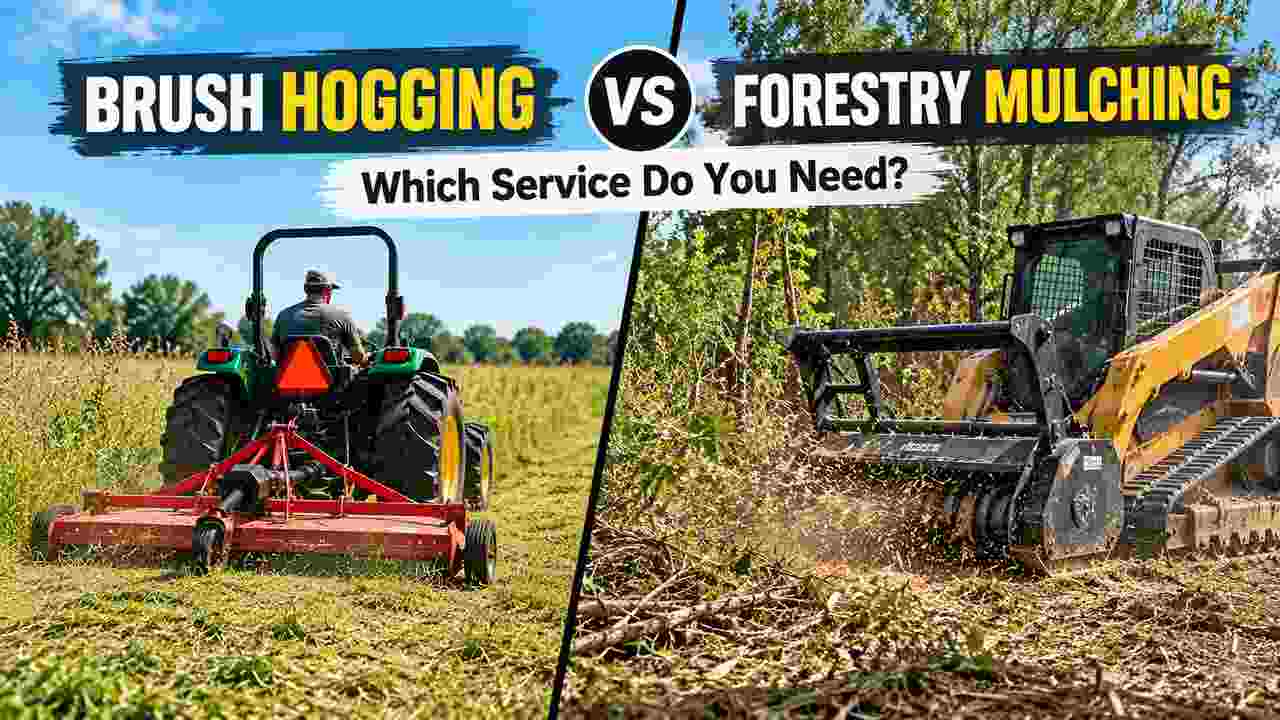
Bush hogging vs forestry mulching comes down to one basic question: are you maintaining an overgrown field, or are you actually clearing woody vegetation?
Bush hogging is usually the simpler choice for grass, weeds, pasture growth and brush that a properly matched rotary cutter is designed to handle. Forestry mulching moves into a different class of work: dense brush, saplings, woody understory and some small trees are processed with a high-powered mulching head rather than simply cut down.
If your property is mostly open ground that has become tall and messy, start by considering bush hogging. If the land has begun turning into woods, contains dense woody growth, or needs material ground into mulch rather than simply knocked down, forestry mulching may be the better tool.
The important point is that neither service is automatically “better.” They solve different problems.
What Is Bush Hogging?
Bush hogging, also called brush hogging or rotary cutting, uses a rotary cutter attached to a tractor or another suitable carrier to cut vegetation.
It is commonly used for:
- Pasture maintenance
- Tall grass
- Weeds
- Overgrown fields
- Roadside vegetation
- Light to heavier brush when the cutter is rated for it
- Keeping previously cleared acreage from growing back
- The cut vegetation normally remains on the ground.
- A rotary cutter is built for rough vegetation rather than the finished appearance of a lawn mower.
Bush Hog’s own equipment range shows why vegetation limits should never be reduced to one universal number. Its current single-spindle cutters range from models rated for approximately 1-inch material to extreme-duty models rated for substantially heavier vegetation. Multi-spindle cutters also have different published cutting capacities depending on the model.
That means the correct question is not simply “Can a bush hog cut saplings?”
The better question is:
What cutting capacity does this exact rotary cutter have, and what vegetation is actually on the property?
What Is Forestry Mulching?
Forestry mulching uses a specialized mulching head mounted on equipment such as a compact track loader, skid steer, excavator or dedicated forestry carrier.
Instead of simply cutting vegetation and leaving relatively large stems behind, the mulching head processes woody material into much smaller pieces.
Forestry mulching is commonly used for:
Dense brush
Woody understory
Saplings
Small trees within the machine’s rated capacity
Trail creation
Fence-line clearing
Right-of-way work
Reclaiming land that has progressed beyond ordinary field maintenance
Bobcat describes its mulcher attachments as tools for processing heavy brush and trees while leaving the material behind as mulch. The exact material capacity depends on the specific mulcher and carrier rather than a universal forestry-mulching diameter.
Bush Hogging vs Forestry Mulching at a Glance
Bush Hogging
Best suited for:
Grass, weeds, pasture growth and vegetation within the rotary cutter’s rated capacity
Typical machine:
Tractor with rotary cutter
What happens to vegetation:
Cut and left on the ground
Best role:
Maintenance and reclaiming relatively open acreage
Major advantage:
Usually simpler and faster on open fields
Main limitation:
Dense woody growth can exceed the cutter’s design or make the job inefficient
Forestry Mulching
Best suited for:
Dense brush, woody understory, saplings and small trees within the mulcher’s rated capacity
Typical machine:
Tracked or wheeled carrier with forestry mulching head
What happens to vegetation:
Ground into smaller mulch material and left onsite
Best role:
Land reclamation and woody vegetation clearing
Major advantage:
Can process material that ordinary pasture mowing equipment cannot efficiently handle
Main limitation:
More specialized equipment and usually unnecessary for simple pasture mowing
When Bush Hogging Is the Better Choice
The Property Is Mostly Grass and Weeds
If the acreage is fundamentally still a field or pasture, bush hogging is usually the first service to investigate.
Tall grass may look dramatic, especially after a property has been neglected for a year or two, but height alone does not automatically mean forestry mulching is necessary.
The composition of the vegetation matters more.
A field filled with tall grass and weeds is very different from the same acreage filled with woody stems and young trees.
You Need Routine Acreage Maintenance
Bush hogging is especially useful when the goal is to prevent open land from transitioning into heavy brush.
Regular cutting can help maintain:
Pastures
Vacant acreage
Hunting land
Field edges
Large rural lots
Previously cleared properties
In this situation, forestry mulching can be substantially more equipment than the job requires.
The Land Is Already Relatively Open
Tractors and rotary cutters work efficiently when they can make long passes without constantly maneuvering around dense trees and obstacles.
This is why field shape, access and vegetation density matter as much as total acreage.
The companion TractorsNearMe guide, How Long Does It Take to Bush Hog 10 Acres?, explains how cutter width, ground speed and field efficiency affect mowing time.
When Forestry Mulching Is the Better Choice
The Property Is Becoming Woodland
A neglected pasture can gradually change from grass to briars, brush, saplings and eventually young trees.
At some point, ordinary mowing stops being a maintenance problem and becomes a land-clearing problem.
That transition is where forestry mulching becomes much more relevant.
Woody Growth Dominates the Property
If most of the obstruction is woody rather than grassy, repeatedly trying to attack it with a rotary cutter may be inefficient or outside the cutter’s rated capacity.
A forestry mulcher is specifically designed to process woody vegetation.
The exact size of material it can handle depends on the mulching head, hydraulic capability, carrier and manufacturer specifications.
Do not hire a contractor based only on a claim such as “our mulcher handles X-inch trees.” Ask which machine and attachment will actually be brought to the property.
You Want Material Processed Into Mulch
Bush hogging cuts vegetation.
Forestry mulching does more processing.
Bobcat describes mulching as suitable when the goal is to leave processed vegetation onsite as ground cover rather than create piles that must be removed.
That can be useful for:
Trails
Property edges
Understory
Fence lines
Overgrown wooded acreage
Right-of-way vegetation
It does not mean the final surface will automatically look like a finished lawn.
Can a Bush Hog Cut Small Trees?
Sometimes, but the answer depends completely on the rotary cutter.
There is no honest universal diameter.
Bush Hog’s current product range demonstrates this clearly.
Some lighter single-spindle models are rated around 1 inch.
Bush Hog BH210-3 models are published with approximately 2-inch cutting capacity.
BH310-2 models are rated around 3 inches.
Heavier BH410 models are listed around 4 inches.
The extreme-duty BH510 series reaches approximately 5 inches according to Bush Hog’s published specifications.
Those ratings apply to particular equipment.
They do not mean every tractor can safely cut material of that diameter, and they should never be transferred to another brand or model without checking its specifications.
The tractor must also be properly matched to the cutter.
If a property contains heavy woody growth throughout rather than occasional stems, cutter capacity alone does not mean bush hogging is the best approach.
Which Method Is Faster?
There is no universal winner because the two machines are doing different work.
On an open pasture, a tractor and appropriately sized rotary cutter can cover acreage efficiently.
Using a forestry mulcher to perform ordinary pasture maintenance would often be unnecessary.
But put the same tractor into acreage dominated by dense woody stems, trees and tangled understory and the comparison changes completely.
A forestry mulcher may become the more efficient machine because it is designed for the material being cleared.
Therefore:
Open field + mowable vegetation = bush hogging usually has the advantage
Dense woody property + clearing objective = forestry mulching usually has the advantage
Do not compare equipment productivity without comparing the vegetation first.
Which Service Costs Less?
For straightforward field maintenance, bush hogging is generally the lower-complexity service because the equipment and job are fundamentally different from forestry mulching.
But publishing one national dollars-per-acre comparison would be misleading.
Bush hogging cost can change with:
Travel
Minimum service charge
Acreage
Vegetation density
Terrain
Obstacles
Cutter width
Number of passes
Forestry mulching pricing can change with:
Vegetation density
Stem and tree size
Terrain
Machine required
Access
Acreage
Desired finish
Whether additional clearing or cleanup is required
Rather than relying on a generic national price, compare actual quotes for the property.
For bush hogging pricing methodology, see How Much to Charge for Bush Hogging Per Acre in 2026.
Texas property owners can also see How Much Does Bush Hogging Cost in Texas?
What Does Each Service Leave Behind?
After Bush Hogging
Expect cut vegetation to remain where it falls.
Depending on the material, the result may include:
Cut grass
Shredded weeds
Coarser brush fragments
Short woody stems
Uneven material distribution
Bush hogging is rough-cut vegetation management, not landscape finishing.
After Forestry Mulching
The mulching head processes vegetation into smaller material that remains on the ground.
The result varies with vegetation, machine, operator technique and the number of passes.
The land does not automatically become:
Graded
Stump-free
Ready for construction
Seeded pasture
Finished lawn
If one of those is the actual goal, additional work may be required.
Bush Hogging or Forestry Mulching for an Overgrown Pasture?
Start by determining whether it is still a pasture.
If most of the acreage is grass and weeds with scattered brush that the contractor’s rotary cutter is rated to handle, bush hogging may be enough.
If large areas have converted into dense saplings, woody thickets or young woodland, ask contractors to evaluate forestry mulching.
Some properties need both.
A badly neglected field may be mulched once to reclaim it and then maintained with periodic bush hogging afterward.
That can be a more useful way to think about the services:
Forestry mulching can reclaim certain properties. Bush hogging can then help maintain the open acreage.
Can You Use Both Services on the Same Property?
Yes.
Large rural properties rarely contain only one type of vegetation.
For example:
- Open pasture may need bush hogging.
- Dense fence lines may need forestry mulching.
- Wooded edges may need selective mulching.
- Accessible grassy sections may only need routine mowing.
Using one machine everywhere simply because it is already onsite is not necessarily the most economical solution.
The job should be divided according to vegetation and the desired result.
How to Decide Before Calling a Contractor
Look at the Vegetation
Is it primarily:
Grass and weeds?
Briars?
Saplings?
Woody shrubs?
Young trees?
Mixed growth?
Check Stem Size
Photograph the thickest representative stems.
Do not estimate from a distance.
Measure Access
Note:
Gate width
Low branches
Soft ground
Steep areas
Ditches
Fence openings
Trailer access
Decide What You Want Afterward
Do you want:
Vegetation knocked down?
An open pasture?
A trail?
Fence-line access?
Woody material processed?
Land prepared for another operation?
The desired result often determines the machine more clearly than the current appearance.
Need Bush Hogging or Tractor Work Near You?
If your property mainly needs bush hogging, pasture mowing or other tractor work, use the TractorsNearMe Local Tractor Work Near Me request form.
Provide:
- Property location
- Acreage requiring work
- Recent photographs
- Vegetation type
- Approximate stem size
- Gate width
- Terrain
- Known rocks, wire or stumps
- Desired result
Those details make it much easier to determine whether the job belongs in the bush-hogging category or requires heavier land-clearing equipment.
1 thought on “Bush Hogging vs Forestry Mulching: Which Do You Need?”