
Contents
Learn how to locate underground water lines safely, including plastic, PVC, and copper water lines, water line leaks, and underground water and sewer line locations before digging.
Finding an underground water line is not always as simple as looking at the yard and guessing where the pipe runs. Water lines can be buried under lawns, driveways, gardens, sidewalks, barns, sheds, patios, or gravel areas. Sometimes they follow a straight path from the meter to the house. Other times, especially on older properties, farms, rural homes, or renovated lots, the line may take an unexpected route.
If you are planning to dig for a fence post, irrigation repair, trench, drainage project, landscaping job, driveway work, or utility installation, you need to know where your underground water lines are before you start. In the U.S., homeowners and contractors should contact 811 before digging so underground utilities can be marked; 811 is the national call-before-you-dig resource for homeowners and professionals. (commongroundalliance.com)
Still, there is one important detail many people miss: 811 usually focuses on public utility lines, and private lines on your property may not always be fully marked. Private lines can include water lines to barns, shops, detached garages, irrigation systems, wells, pools, fountains, or outbuildings. For those, you may need your own records, visual clues, a private utility locator, or specialized locating equipment.
How to Locate Underground Water Lines
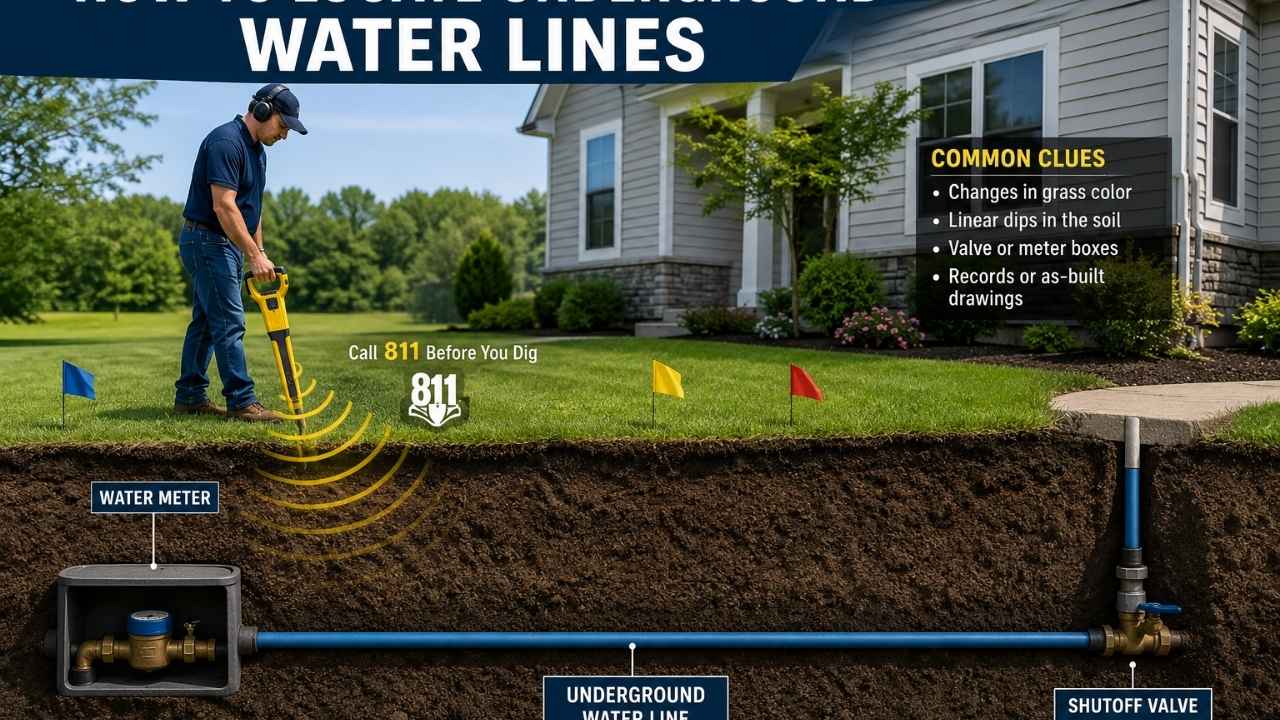
The best way to locate underground water lines is to start with known connection points. Find your water meter, well head, pressure tank, main shutoff valve, hose bibs, sprinkler controls, or the point where the water line enters the house. In many homes, the main water line runs from the meter or well toward the house in the most direct route possible. However, you should not assume the line is perfectly straight.
Look for clues in the yard. A sunken strip of soil, greener grass, unusually wet ground, old trench marks, a line of repaired concrete, or a row of utility flags can suggest where a water line may run. On rural properties, underground water lines may run from the house to barns, livestock waterers, garden hydrants, workshops, or irrigation zones.
Old property documents can also help. Check building plans, plumbing records, well installation paperwork, irrigation plans, septic drawings, or old invoices from plumbers and excavators. Even a rough sketch from a previous repair can save time.
If you need a more accurate locate, use a professional utility locating service. Professionals may use pipe locators, ground-penetrating radar, acoustic leak detection, tracer wire, sondes, or other tools depending on the pipe material and site conditions. This is especially useful if you plan to dig near the suspected water line.
How to Locate a Plastic Water Line Underground
Locating a plastic water line underground can be harder than locating metal pipe because plastic does not conduct electricity. A standard electromagnetic pipe locator works best when there is a conductive material to trace. If the plastic water line has tracer wire installed with it, the job becomes much easier. The locator can connect to the tracer wire and follow the path of the pipe.
If there is no tracer wire, you may need a different approach. You can start by identifying the water source and destination, then carefully map the most likely route. Look for valve boxes, hydrants, irrigation controls, water meter boxes, or areas where the ground has settled. If the pipe is shallow enough and conditions are right, ground-penetrating radar may help, but results depend on soil type, depth, moisture, and pipe size.
For private plastic lines, a professional locator is often the safest choice. Some companies can insert a small transmitter or sonde into a pipe if there is access. Others may use acoustic equipment if water is flowing or if a leak is suspected. The correct method depends on whether the line is active, accessible, pressurized, and made from plastic, polyethylene, or another non-metallic material.
How to Locate PVC Water Lines Underground
PVC water lines create a similar challenge because PVC is non-metallic. If the PVC pipe was installed with tracer wire, locating it is usually straightforward. If it was not, you may need to rely on access points, records, surface clues, and professional locating tools.
Start by finding the main water meter, shutoff valve, irrigation valve box, or point where the PVC line connects to another system. Then trace the most logical route between those points. PVC water lines are often installed in relatively direct paths, but landscaping changes, additions, driveways, and previous repairs can alter the route.
If you are trying to locate PVC water lines for irrigation, check the sprinkler valve boxes first. Irrigation main lines often run from the water source to a manifold, then branch out to individual zones. The lateral lines may not be very deep, but the main line may be deeper and under pressure.
When accuracy matters, hire a private utility locator. This is especially important before trenching, using an auger, installing fence posts, or digging near a foundation. PVC may be tough, but it can still crack or break if hit with equipment.
How to Locate a Copper Water Line Underground
A copper water line is usually easier to locate than plastic or PVC because copper is conductive. A professional locator can often trace a copper line with electromagnetic locating equipment. The locator sends a signal through the pipe or detects a signal from the line, then follows it across the property.
If you suspect your underground water line is copper, look for copper pipe where the water service enters the home, near the meter, or around older plumbing connections. Many older homes used copper service lines, although some properties may have been repaired with plastic, PVC, or PEX in certain sections.
Copper lines can corrode, develop pinhole leaks, or be affected by soil conditions over time. If you are locating a copper line because of low water pressure, wet soil, or a high water bill, you may also need leak detection. A plumber or leak detection specialist can help confirm whether the problem is the copper line itself or another part of the plumbing system.
How to Locate an Underground Water Line Leak
Locating an underground water line leak starts with recognizing the warning signs. Common signs include a sudden increase in the water bill, low water pressure, wet or soggy spots in the yard, greener grass in one area, muddy soil, water pooling with no obvious source, or the sound of running water when all fixtures are turned off.
A simple first step is to check your water meter. Turn off all faucets, appliances, irrigation zones, and water-using fixtures. Then look at the meter. If it continues moving, you may have a leak somewhere in the system. This does not always prove the leak is underground, but it tells you water may be moving when it should not be.
Finding the exact leak location can be difficult. Water does not always surface directly above the broken pipe. It can travel along trenches, roots, gravel, or compacted soil before appearing in another area. Professionals often use acoustic leak detection, pressure testing, thermal imaging, tracer gas, or other methods to narrow down the leak.
If the leak is on a main water line, avoid random digging. Digging in the wrong place wastes time and can damage other utilities. A leak detection specialist or plumber can usually locate the problem more accurately before excavation begins.
How to Locate Underground Water and Sewer Lines
Water lines and sewer lines often run in different directions, but both matter before digging. The water line usually brings clean pressurized water into the house, while the sewer line carries wastewater away from the home. On many properties, the water line runs from the meter or well to the house, and the sewer line runs from the house to the municipal sewer main or septic tank.
To locate underground water and sewer lines, begin with visible access points. For water, check the meter, well, main shutoff, pressure tank, and hose bibs. For sewer, check cleanouts, basement plumbing exits, septic tank lids, inspection ports, or municipal sewer connection records.
Sewer lines are usually larger than water lines and may follow a slope away from the house. Water lines are pressurized and can run uphill or downhill. Because the two systems work differently, they may not be buried at the same depth or follow the same path.
Before digging, contact 811 to request utility marking. Utility companies or local operators may mark underground lines using paint or flags, and state 811 centers notify operators in your area to mark buried utility lines before excavation. (utc.wa.gov) For private water or sewer laterals, irrigation lines, septic lines, or lines to outbuildings, you may still need a private locator because not every private line is covered by the public locate process. Some private utility locating companies specifically note that 811 may not mark secondary private utilities or provide line depths. (gp-radar.com)
Locating underground water lines is about more than convenience. It protects your plumbing, prevents costly repairs, and helps you dig safely. Start with known connection points, check property records, look for surface clues, and call 811 before digging. If the line is plastic, PVC, private, unmarked, or connected to a leak, consider hiring a professional locator.
The most important rule is simple: do not guess and dig blindly. Underground water lines can be expensive to repair, and they may run closer to other utilities than you expect. A careful locate before the project can save you from a broken pipe, flooded trench, interrupted water service, or a much bigger repair bill.