
Contents
- 1 Why Tractor Tire Pressure Matters More Than Ever
- 2 Fuel Efficiency and Slip Ratio
- 3 Soil Compaction: The Hidden Enemy
- 4 Tractor Tire Pressure Chart (2026 Updated)
- 5 IF and VF Tires: A Game-Changer in 2026
- 6 Adjusting Tire Pressure Based on Soil Type
- 7 Field vs Road: The Critical Balance
- 8 5 Common Mistakes When Measuring Tire Pressure
- 9 Pro Tip: Small Adjustment, Big Profit
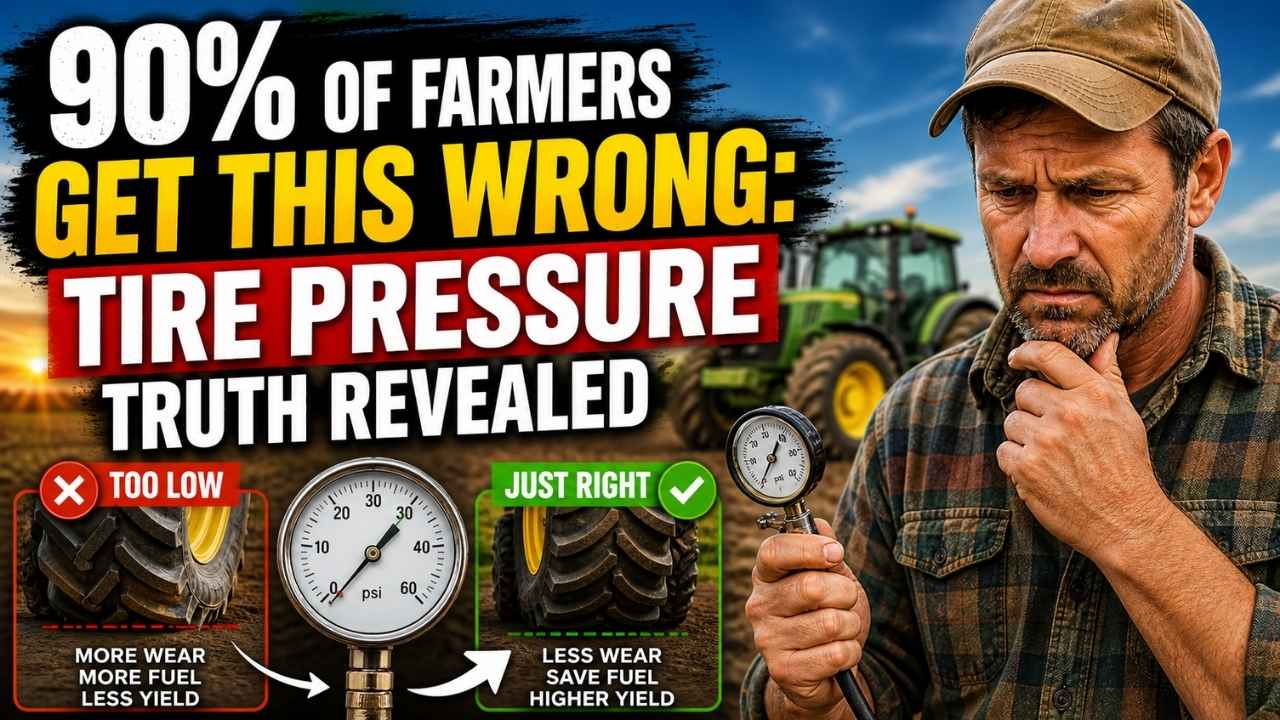
Correct tire pressure isn’t just a number—it’s a critical engineering setting that directly impacts your fuel costs, soil health, and the lifespan of your tractor.
Why Tractor Tire Pressure Matters More Than Ever
Modern agriculture in 2026 has moved far beyond guesswork. While previous generations relied on visual checks, today’s rising fuel prices and soil compaction risks demand precision.
Running incorrect tire pressure can silently cost farmers up to 20% more fuel annually. Even worse, it can compress your soil layers, reducing long-term crop yield.
Here’s the principle:
- High pressure = smaller contact area → more slippage, deeper soil penetration
- Lower pressure (within limits) = wider footprint → better traction, reduced sinking
The result? More efficiency, less waste, and healthier soil.
Fuel Efficiency and Slip Ratio
An ideal field operation should maintain a slip ratio of 10–15%.
If your tires are overinflated, slip can rise to 25% or more.
That means:
- 1 out of every 4 working hours is wasted energy
- Increased fuel consumption
- Faster tire wear
Soil Compaction: The Hidden Enemy
Overinflated tires act like rigid rollers, compressing soil pores. This leads to:
- Poor water infiltration
- Reduced root oxygen
- Long-term yield loss
Once soil is heavily compacted, recovery can take years. Proper tire pressure is not just a setting—it’s a long-term investment in your land.
Tractor Tire Pressure Chart (2026 Updated)
Below is a general reference chart for standard radial tractor tires:
| Operation Type | Ground Condition | Recommended PSI | Recommended Bar |
|---|---|---|---|
| Heavy Tillage (Plowing) | Soft Soil | 8 – 12 PSI | 0.6 – 0.8 Bar |
| Seeding & Preparation | Cultivated Soil | 9 – 14 PSI | 0.6 – 1.0 Bar |
| Spraying / Fertilizing | Dry / Hard Soil | 12 – 16 PSI | 0.8 – 1.1 Bar |
| Road Transport | Asphalt / Concrete | 22 – 30 PSI | 1.5 – 2.0 Bar |
| Front Loader Use | Hard Surface | 25 – 35 PSI | 1.7 – 2.4 Bar |
Always refer to your tire manufacturer’s specifications for exact values.
IF and VF Tires: A Game-Changer in 2026
New-generation tires like IF (Increased Flexion) and VF (Very High Flexion) offer major advantages:
- Carry up to 40% more load at the same pressure
- Reduce soil compaction significantly
- Improve traction and fuel efficiency
If you’re upgrading your equipment, these tires are worth serious consideration.
Adjusting Tire Pressure Based on Soil Type
Every soil type behaves differently. Smart pressure management is key.
Sandy Soil
- Lower pressure to maximize footprint
- Prevents sinking and improves flotation
Clay / Wet Soil
- Avoid too low pressure (risk of clogging and loss of traction)
- Maintain balanced pressure for grip
General Rules
- Soft ground: Reduce pressure by 20–30%
- Hard ground: Increase to standard levels
- Sloped terrain: Increase pressure by ~10% for stability
Field vs Road: The Critical Balance
Tractors don’t operate only in fields. Transitioning between field and road requires pressure adjustments.
In the Field
- Low pressure
- Wide contact area
- Maximum traction
On the Road
- Higher pressure
- Reduced rolling resistance
- Better steering and braking
Driving on asphalt with low pressure can overheat tire sidewalls and cause structural damage.
5 Common Mistakes When Measuring Tire Pressure
Avoid these costly errors:
- Measuring hot tires
→ Heat increases pressure readings. Always measure when cold. - Using inaccurate gauges
→ Cheap tools can be off by 3–4 PSI. - Ignoring front tires
→ Critical for 4WD system performance. - Not accounting for implement weight
→ Equipment load drastically changes pressure needs. - Relying on visual inspection
→ “Looks fine” is not data. Always measure.
Pro Tip: Small Adjustment, Big Profit
Lowering pressure in the field and increasing it on the road may seem inconvenient—but it can:
- Save significant fuel costs
- Extend tire life by up to 30%
- Improve overall productivity
Optimizing tractor tire pressure is one of the simplest yet most powerful ways to increase efficiency in modern farming.
By following a proper tractor tire pressure chart, adjusting for soil conditions, and avoiding common mistakes, you can:
- Reduce fuel consumption
- Protect your soil structure
- Extend equipment lifespan
- Increase overall yield